Ch. 11 - Parametric Equations and Polar Coordinates
Hass - Thomas' Calculus 15th Edition
Hass15th EditionThomas' CalculusISBN: 9780137616077Non è quello che usi tu?Cambia libro di testo
Capitolo 11, Problema 11.6.74b

Theory and Examples


Volume Find the volume of the solid generated by revolving the region enclosed by the ellipse 9x² + 4y² = 36 about the y−axis.

Guida verificata passo dopo passo
1
Rewrite the equation of the ellipse 9x^{2} + 4y^{2} = 36 in terms of x to express x as a function of y. Start by isolating x^{2}: 9x^{2} = 36 - 4y^{2}, so x^{2} = \(\frac{36 - 4y^{2}\)}{9}. Then, x = \(\pm\) \(\sqrt{\frac{36 - 4y^{2}\)}{9}} = \(\pm\) \(\frac{\sqrt{36 - 4y^{2}\)}}{3}.
Identify the limits of integration for y by finding the range of y-values on the ellipse. Since the ellipse is symmetric about the x-axis, find the maximum and minimum y by setting x=0 in the ellipse equation: 9(0)^{2} + 4y^{2} = 36 \(\Rightarrow\) 4y^{2} = 36 \(\Rightarrow\) y^{2} = 9 \(\Rightarrow\) y = \(\pm\) 3. So, y ranges from -3 to 3.
Set up the volume integral using the method of cylindrical shells because the solid is generated by revolving around the y-axis. The formula for volume using shells is: \(V = \int_{a}^{b} 2\pi (\text{radius})(\text{height}) \, dy\). Here, the radius is the distance from the y-axis, which is |x|, and the height is the thickness dy.
Express the radius and height in terms of y. The radius is the x-value, which from step 1 is \(\frac{\sqrt{36 - 4y^{2}}}{3}\). The height of each shell is the horizontal distance from -x to x, which is \(2x = 2 \times \frac{\sqrt{36 - 4y^{2}}}{3}\). However, since the shell method integrates with respect to y, the height corresponds to the horizontal length, so the height is \$2x$ and the radius is $|y|$ if revolving around y-axis, but since we revolve around y-axis, the radius is $x$ and height is dy. Actually, for revolving around y-axis, the shell radius is $|x|$ and height is the vertical segment in y, so we should integrate with respect to x. Alternatively, use the disk/washer method integrating with respect to y.
Use the disk/washer method integrating with respect to y. The radius of each disk is the x-value from the ellipse, \(R(y) = \frac{\sqrt{36 - 4y^{2}}}{3}\). The volume is then \(V = \pi \int_{-3}^{3} [R(y)]^{2} dy = \pi \int_{-3}^{3} \left( \frac{\sqrt{36 - 4y^{2}}}{3} \right)^{2} dy\). Simplify the integrand and set up the integral to find the volume.

Risposta video verificata per un problema simile:

Questa soluzione video è stata consigliata dai nostri tutor come utile per risolvere questo problema.
Durata del video:
8m

Concetti chiave

Ecco i concetti essenziali che devi comprendere per rispondere correttamente alla domanda.

Equation of an Ellipse

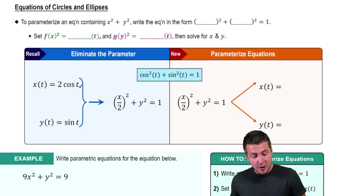
An ellipse is defined by an equation of the form (x²/a²) + (y²/b²) = 1, where a and b are the semi-major and semi-minor axes. Understanding how to rewrite the given ellipse equation 9x² + 4y² = 36 into this standard form helps identify the boundaries of the region to be revolved.
Video consigliato:
06:03
Parameterizing Equations of Circles & Ellipses

Method of Cylindrical Shells

The cylindrical shells method calculates volume by integrating the lateral surface area of thin cylindrical shells formed by revolving vertical slices around an axis. It is especially useful when revolving regions around the y-axis, as it involves integrating with respect to x.
Video consigliato:
07:33
Euler's Method

Volume of Solids of Revolution

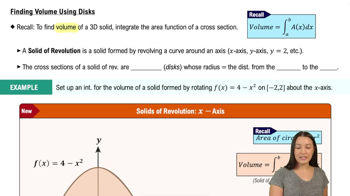
Solids of revolution are formed by rotating a plane region about an axis. The volume can be found using integral calculus methods such as the disk/washer or shell method, which involve setting up and evaluating definite integrals based on the shape and axis of rotation.
Video consigliato:
04:48
Finding Volume Using Disks