
Ch. 2 - Limits and Continuity
Hass - Thomas' Calculus 15th Edition
Hass15th EditionThomas' CalculusISBN: 9780137616077Non è quello che usi tu?Cambia libro di testo
Capitolo 2, Problema 2.2.10

If f(1)=5, must limx→1 f(x) exist? If it does, then must limx→1 f(x)=5? Can we conclude anything about limx→1 f(x)? Explain.

Guida verificata passo dopo passo
1
To determine if \( \lim_{x \to 1} f(x) \) exists, we need to check if the function \( f(x) \) approaches a specific value as \( x \) approaches 1 from both the left and the right.
The existence of \( f(1) = 5 \) does not necessarily imply that \( \lim_{x \to 1} f(x) \) exists. A limit exists only if the left-hand limit and the right-hand limit are equal as \( x \) approaches 1.
If \( \lim_{x \to 1} f(x) \) does exist, it does not have to equal \( f(1) = 5 \). The limit describes the behavior of \( f(x) \) as \( x \) approaches 1, not necessarily the value of \( f(x) \) at \( x = 1 \).
To conclude anything about \( \lim_{x \to 1} f(x) \), we need more information about the behavior of \( f(x) \) near \( x = 1 \). For example, if \( f(x) \) is continuous at \( x = 1 \), then \( \lim_{x \to 1} f(x) = f(1) = 5 \).
In summary, without additional information about the continuity or behavior of \( f(x) \) near \( x = 1 \), we cannot definitively conclude the value of \( \lim_{x \to 1} f(x) \).

Risposta video verificata per un problema simile:

Questa soluzione video è stata consigliata dai nostri tutor come utile per risolvere questo problema.
Durata del video:
4m

Concetti chiave

Ecco i concetti essenziali che devi comprendere per rispondere correttamente alla domanda.

Limit of a Function

The limit of a function describes the value that the function approaches as the input approaches a certain point. For a limit to exist at a point, the function must approach the same value from both the left and right sides of that point. This concept is fundamental in calculus as it helps in understanding continuity and the behavior of functions near specific points.
Video consigliato:
06:11
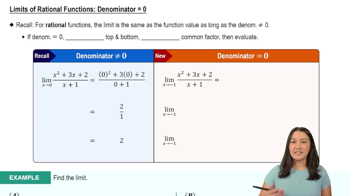
Limits of Rational Functions: Denominator = 0

Continuity

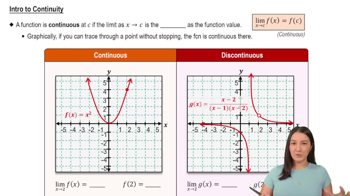
A function is continuous at a point if the limit of the function as it approaches that point equals the function's value at that point. In this case, if f(1) = 5 and the limit as x approaches 1 exists, then for the function to be continuous at x = 1, it must also hold that lim x→1 f(x) = 5. Continuity ensures that there are no jumps or breaks in the function at that point.
Video consigliato:
05:34
Intro to Continuity

Existence of Limits

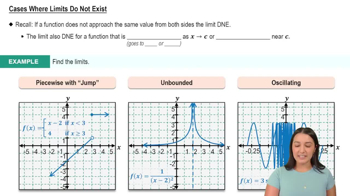
The existence of a limit does not necessarily imply that the function is defined at that point. In the given question, even if f(1) = 5, the limit lim x→1 f(x) may exist and be different from 5, or it may not exist at all. Understanding this distinction is crucial for analyzing the behavior of functions and their limits in calculus.
Video consigliato:
03:07
Cases Where Limits Do Not Exist
Pratica correlata
Domanda del libro di testo

Limits as x → ∞ or x → −∞


The process by which we determine limits of rational functions applies equally well to ratios containing noninteger or negative powers of x. Divide numerator and denominator by the highest power of x in the denominator and proceed from there. Find the limits in Exercises 23–36. Write ∞ or −∞ where appropriate.


lim x→⁻∞ (³√x − ⁵√x) / (³√x + ⁵√x)

314
views
Domanda del libro di testo

Find the limits in Exercises 31–40. Are the functions continuous at the point being approached?


lim x → 0 tan (π/4 cos (sin x¹/³))

217
views
Domanda del libro di testo

Finding Limits

In Exercises 25–28, find the limit of g(x) as x approaches the indicated value.


5 ―x²

lim ------------- = 0

x → ―2 (√g(x))


265
views
Domanda del libro di testo

Using limθ→0 sin θ / θ = 1


Find the limits in Exercises 23–46.


llimx→0 (x −x cos x) / sin² 3x

279
views
Domanda del libro di testo

In Exercises 1–4, say whether the function graphed is continuous on [−1, 3]. If not, where does it fail to be continuous and why?

<IMAGE>

300
views
Domanda del libro di testo

Limits as x → ∞ or x → −∞


The process by which we determine limits of rational functions applies equally well to ratios containing noninteger or negative powers of x. Divide numerator and denominator by the highest power of x in the denominator and proceed from there. Find the limits in Exercises 23–36. Write ∞ or −∞ where appropriate.


lim x→∞ √(x² + 1) / (x + 1)

269
views