Ch. 2 - Limits and Continuity
Hass - Thomas' Calculus 15th Edition
Hass15th EditionThomas' CalculusISBN: 9780137616077Non è quello che usi tu?Cambia libro di testo
Capitolo 2, Problema 2.5.4

In Exercises 1–4, say whether the function graphed is continuous on [−1, 3]. If not, where does it fail to be continuous and why?
<IMAGE>

Guida verificata passo dopo passo
1
Step 1: Understand the definition of continuity. A function is continuous on an interval if it is continuous at every point in that interval. A function is continuous at a point if the limit of the function as it approaches the point from both sides is equal to the function's value at that point.
Step 2: Identify the interval of interest, which is [-1, 3]. This means we need to check the continuity of the function at every point within this interval, including the endpoints -1 and 3.
Step 3: Examine the graph of the function over the interval [-1, 3]. Look for any breaks, jumps, or holes in the graph, as these indicate points where the function may not be continuous.
Step 4: Check the endpoints of the interval. Ensure that the function is defined at x = -1 and x = 3, and that the limits from the left and right at these points match the function's value at these points.
Step 5: Identify any points within the interval where the function is not continuous. This could be due to a jump discontinuity, an infinite discontinuity, or a removable discontinuity. Note these points and explain why the function fails to be continuous at each one.

Risposta video verificata per un problema simile:

Questa soluzione video è stata consigliata dai nostri tutor come utile per risolvere questo problema.
Durata del video:
2m

Concetti chiave

Ecco i concetti essenziali che devi comprendere per rispondere correttamente alla domanda.

Continuity of Functions

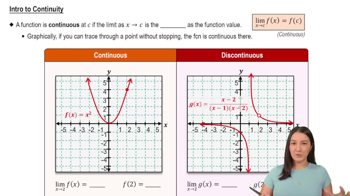
A function is continuous on an interval if there are no breaks, jumps, or holes in its graph within that interval. Formally, a function f(x) is continuous at a point c if the limit of f(x) as x approaches c equals f(c). Understanding this concept is crucial for determining whether a function is continuous over a specified range.
Video consigliato:
05:34
Intro to Continuity

Types of Discontinuities

Discontinuities can be classified into three main types: removable, jump, and infinite. A removable discontinuity occurs when a function is not defined at a point but can be made continuous by redefining it. A jump discontinuity happens when the left-hand and right-hand limits at a point do not match, while an infinite discontinuity occurs when the function approaches infinity at a point. Identifying these types helps in pinpointing where a function fails to be continuous.
Video consigliato:
05:25
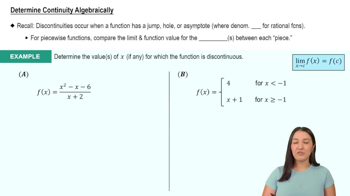
Determine Continuity Algebraically

Evaluating Limits

Limits are fundamental in analyzing the behavior of functions as they approach specific points. To determine continuity, one must evaluate the limit of the function at the endpoints and any critical points within the interval. If the limit exists and equals the function's value at those points, the function is continuous there. This concept is essential for assessing continuity over a given interval.
Video consigliato:
05:50
One-Sided Limits