Ch. 2 - Limits and Continuity
Hass - Thomas' Calculus 15th Edition
Hass15th EditionThomas' CalculusISBN: 9780137616077Non è quello che usi tu?Cambia libro di testo
Capitolo 2, Problema 2.6.77

In Exercises 77–80, find a function that satisfies the given conditions and sketch its graph. (The answers here are not unique. Any function that satisfies the conditions is acceptable. Feel free to use formulas defined in pieces if that will help.)


lim x → ±∞ f(x) = 0, lim x → 2⁻ f(x) = ∞, and lim x → 2⁺ f(x) = ∞

Guida verificata passo dopo passo
1
First, let's understand the conditions given for the function f(x). The condition lim x → ±∞ f(x) = 0 suggests that as x approaches positive or negative infinity, the function approaches zero. This is characteristic of functions that have horizontal asymptotes at y = 0.
Next, consider the condition lim x → 2⁻ f(x) = ∞ and lim x → 2⁺ f(x) = ∞. These conditions indicate that as x approaches 2 from the left and right, the function approaches infinity. This suggests a vertical asymptote at x = 2.
A function that satisfies these conditions could be a rational function with a vertical asymptote at x = 2 and horizontal asymptotes at y = 0. One example is f(x) = 1/(x-2)^2. This function has a vertical asymptote at x = 2 and approaches zero as x approaches ±∞.
To sketch the graph of f(x) = 1/(x-2)^2, note that the graph will have a vertical asymptote at x = 2, meaning the function will shoot up to infinity as x approaches 2 from either side. The graph will also approach the x-axis (y = 0) as x moves towards positive or negative infinity.
Finally, verify the behavior of the function at the asymptotes. As x approaches 2 from the left (x → 2⁻), f(x) = 1/(x-2)^2 tends to infinity, and similarly, as x approaches 2 from the right (x → 2⁺), f(x) also tends to infinity. As x approaches ±∞, f(x) approaches 0, confirming the horizontal asymptote at y = 0.

Risposta video verificata per un problema simile:

Questa soluzione video è stata consigliata dai nostri tutor come utile per risolvere questo problema.
Durata del video:
2m

Concetti chiave

Ecco i concetti essenziali che devi comprendere per rispondere correttamente alla domanda.

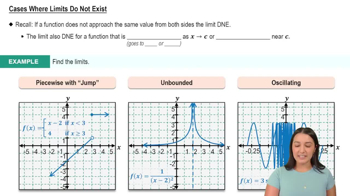
Limits at Infinity

Limits at infinity describe the behavior of a function as the input approaches positive or negative infinity. In this context, lim x → ±∞ f(x) = 0 indicates that as x becomes very large or very small, the function f(x) approaches zero. This often suggests a horizontal asymptote at y = 0, which is crucial for sketching the graph of the function.
Video consigliato:
03:07
Cases Where Limits Do Not Exist

Vertical Asymptotes

A vertical asymptote occurs when a function approaches infinity as the input approaches a specific value. Here, lim x → 2⁻ f(x) = ∞ and lim x → 2⁺ f(x) = ∞ indicate that the function has a vertical asymptote at x = 2. This means the function's value increases without bound as x approaches 2 from either direction, which is essential for understanding the function's behavior near this point.
Video consigliato:
Percorso guidato
3:40
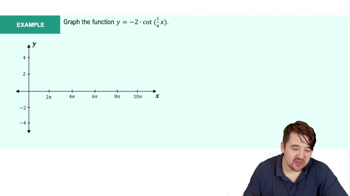
Introduction to Cotangent Graph Example 1

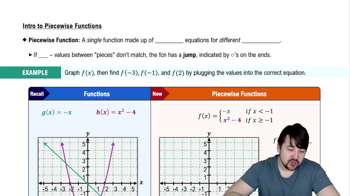
Piecewise Functions

Piecewise functions are defined by different expressions over different intervals of the domain. In this problem, using a piecewise function can help construct a function that meets the given conditions, such as having different behaviors near x = 2 and as x approaches infinity. This flexibility allows for creating a function that satisfies all specified limits and asymptotic behaviors.
Video consigliato:
Percorso guidato
05:36
Piecewise Functions