
Ch. 2 - Limits and Continuity
Hass - Thomas' Calculus 15th Edition
Hass15th EditionThomas' CalculusISBN: 9780137616077Non è quello che usi tu?Cambia libro di testo
Capitolo 2, Problema 2.4.26

Using limθ→0 sin θ / θ = 1


Find the limits in Exercises 23–46.


limh→0− h / sin 3h

Guida verificata passo dopo passo
1
Recognize that the limit limθ→0 sin θ / θ = 1 is a standard limit in calculus, which can be used to evaluate limits involving trigonometric functions.
Rewrite the given limit limh→0− h / sin 3h in a form that resembles the standard limit. Notice that the expression involves sin 3h, so we need to manipulate it to use the standard limit.
Factor out the constant inside the sine function by rewriting the expression as limh→0− (1/3) * (3h / sin 3h). This step involves recognizing that multiplying and dividing by 3 will help us match the standard limit form.
Apply the standard limit limθ→0 sin θ / θ = 1 to the expression 3h / sin 3h. As h approaches 0, 3h also approaches 0, allowing us to use the standard limit.
Conclude that the limit is (1/3) * 1, since the limit of 3h / sin 3h as h approaches 0 is 1. Therefore, the original limit evaluates to 1/3.

Risposta video verificata per un problema simile:

Questa soluzione video è stata consigliata dai nostri tutor come utile per risolvere questo problema.
Durata del video:
3m

Concetti chiave

Ecco i concetti essenziali che devi comprendere per rispondere correttamente alla domanda.

Limit of a Function

The limit of a function describes the behavior of that function as its input approaches a certain value. In calculus, limits are fundamental for defining derivatives and integrals. Understanding limits helps in evaluating expressions that may be indeterminate or undefined at specific points.
Video consigliato:
06:11
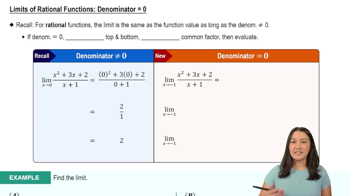
Limits of Rational Functions: Denominator = 0

Sine Function and Its Properties

The sine function, denoted as sin(θ), is a periodic function that relates the angle θ to the ratio of the opposite side to the hypotenuse in a right triangle. A key property of the sine function is that as θ approaches 0, sin(θ) approaches θ, which is crucial for evaluating limits involving sin(θ) and θ.
Video consigliato:
Percorso guidato
06:21
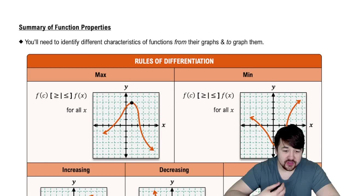
Properties of Functions

L'Hôpital's Rule

L'Hôpital's Rule is a method for evaluating limits of indeterminate forms, such as 0/0 or ∞/∞. It states that if the limit of f(x)/g(x) results in an indeterminate form, the limit can be found by taking the derivative of the numerator and the derivative of the denominator. This rule simplifies the process of finding limits in complex expressions.
Video consigliato:
5:50
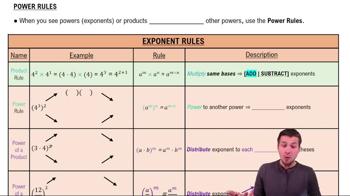
Power Rules
Pratica correlata
Domanda del libro di testo

In Exercises 77–80, find a function that satisfies the given conditions and sketch its graph. (The answers here are not unique. Any function that satisfies the conditions is acceptable. Feel free to use formulas defined in pieces if that will help.)


lim x → ±∞ f(x) = 0, lim x → 2⁻ f(x) = ∞, and lim x → 2⁺ f(x) = ∞

288
views
Domanda del libro di testo

Horizontal and Vertical Asymptotes


Determine the domain and range of y = (√16―x²) / (x―2).

458
views
1
rank
Domanda del libro di testo

Limits as x → ∞ or x → −∞


The process by which we determine limits of rational functions applies equally well to ratios containing noninteger or negative powers of x. Divide numerator and denominator by the highest power of x in the denominator and proceed from there. Find the limits in Exercises 23–36. Write ∞ or −∞ where appropriate.


lim x→∞ (x − 3) / √(4x² + 25)

348
views
Domanda del libro di testo

Using limθ→0 sin θ / θ = 1


Find the limits in Exercises 23–46.


limh→0 sin(sin h) / sin h

362
views
Domanda del libro di testo

Limits as x → ∞ or x → −∞


The process by which we determine limits of rational functions applies equally well to ratios containing noninteger or negative powers of x. Divide numerator and denominator by the highest power of x in the denominator and proceed from there. Find the limits in Exercises 23–36. Write ∞ or −∞ where appropriate.


lim x → ∞ √((8x² − 3) / (2x² + x))

368
views
Domanda del libro di testo

Never-zero continuous functions Is it true that a continuous function that is never zero on an interval never changes sign on that interval? Give reasons for your answer.

280
views