Ch. 2 - Limits and Continuity
Hass - Thomas' Calculus 15th Edition
Hass15th EditionThomas' CalculusISBN: 9780137616077Non è quello che usi tu?Cambia libro di testo
Capitolo 2, Problema 2.6.35

Limits as x → ∞ or x → −∞


The process by which we determine limits of rational functions applies equally well to ratios containing noninteger or negative powers of x. Divide numerator and denominator by the highest power of x in the denominator and proceed from there. Find the limits in Exercises 23–36. Write ∞ or −∞ where appropriate.


lim x→∞ (x − 3) / √(4x² + 25)

Guida verificata passo dopo passo
1
Identify the highest power of x in the denominator. In this case, the highest power is x² under the square root, which simplifies to x when considering the square root.
Divide both the numerator and the denominator by x, the highest power of x in the denominator. This gives us: (x/x - 3/x) / (√(4x² + 25)/x).
Simplify the expression: The numerator becomes (1 - 3/x) and the denominator becomes √(4 + 25/x²).
Evaluate the limit as x approaches infinity: As x → ∞, 3/x approaches 0 and 25/x² approaches 0.
The expression simplifies to (1 - 0) / √(4 + 0), which further simplifies to 1/√4. Calculate the final limit value from this simplified expression.

Risposta video verificata per un problema simile:

Questa soluzione video è stata consigliata dai nostri tutor come utile per risolvere questo problema.
Durata del video:
2m

Concetti chiave

Ecco i concetti essenziali che devi comprendere per rispondere correttamente alla domanda.

Limits at Infinity

Limits at infinity involve finding the behavior of a function as the variable approaches positive or negative infinity. This concept helps determine the end behavior of functions, particularly rational functions, by analyzing the dominant terms. Understanding limits at infinity is crucial for evaluating how functions grow or shrink without bound.
Video consigliato:
03:07
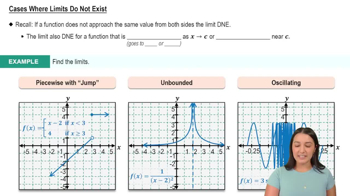
Cases Where Limits Do Not Exist

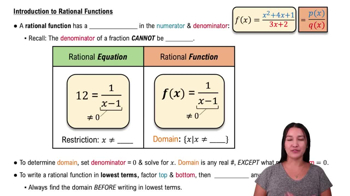
Rational Functions

Rational functions are expressions formed by the ratio of two polynomials. To find limits involving rational functions, especially as x approaches infinity, it's essential to identify the highest power of x in the denominator and numerator. This helps simplify the function and determine its limit by focusing on the dominant terms that influence the function's behavior.
Video consigliato:
6:04
Intro to Rational Functions

Simplification Techniques

Simplification techniques involve dividing the numerator and denominator by the highest power of x present in the denominator. This process reduces the complexity of the function, allowing for easier evaluation of limits. By simplifying, we can isolate terms that significantly impact the limit, making it possible to determine the function's behavior as x approaches infinity.
Video consigliato:
Percorso guidato
05:03
Initial Value Problems