
Ch. 3 - Derivatives
Hass - Thomas' Calculus 15th Edition
Hass15th EditionThomas' CalculusISBN: 9780137616077Non è quello che usi tu?Cambia libro di testo
Capitolo 3, Problema 3.5.53a

By computing the first few derivatives and looking for a pattern, find the following derivatives.


a. d⁹⁹⁹/dx⁹⁹⁹ (cos x)

Guida verificata passo dopo passo
1
Start by computing the first derivative of cos(x). The derivative of cos(x) with respect to x is -sin(x).
Compute the second derivative. The derivative of -sin(x) is -cos(x).
Compute the third derivative. The derivative of -cos(x) is sin(x).
Compute the fourth derivative. The derivative of sin(x) is cos(x).
Notice the pattern: the derivatives cycle every four steps: cos(x), -sin(x), -cos(x), sin(x). Use this pattern to determine the 999th derivative by finding the remainder when 999 is divided by 4.

Risposta video verificata per un problema simile:

Questa soluzione video è stata consigliata dai nostri tutor come utile per risolvere questo problema.
Durata del video:
3m

Concetti chiave

Ecco i concetti essenziali che devi comprendere per rispondere correttamente alla domanda.

Derivatives of Trigonometric Functions

Understanding the derivatives of basic trigonometric functions is essential. The derivative of cos(x) is -sin(x), and the derivative of sin(x) is cos(x). This cyclical pattern continues, with the derivative of -sin(x) being -cos(x), and the derivative of -cos(x) being sin(x). Recognizing this cycle helps in computing higher-order derivatives.
Video consigliato:
Percorso guidato
6:04
Introduction to Trigonometric Functions

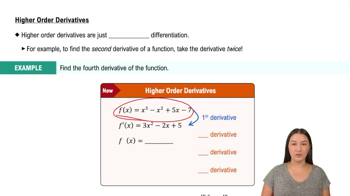
Higher-Order Derivatives

Higher-order derivatives involve taking the derivative of a function multiple times. For trigonometric functions like cos(x), the derivatives repeat in a cycle every four derivatives. This means that the nth derivative can be determined by finding the remainder of n divided by 4, which indicates the position in the cycle.
Video consigliato:
02:42
Higher Order Derivatives

Pattern Recognition in Derivatives

Identifying patterns in derivatives is crucial for efficiently computing higher-order derivatives. By observing the cyclical nature of the derivatives of cos(x), one can predict the 999th derivative by recognizing that it corresponds to the third position in the cycle, which is -sin(x). This pattern recognition simplifies the computation process significantly.
Video consigliato:
Pratica correlata
Domanda del libro di testo

Temperatures in Fairbanks, Alaska The graph in the accompanying figure shows the average Fahrenheit temperature in Fairbanks, Alaska, during a typical 365-day year. The equation that approximates the temperature on day x is


y = 37 sin[(2π/365)(x − 101)] + 25


and is graphed in the accompanying figure.


a. On what day is the temperature increasing the fastest?


" style="" width="420">

273
views
Domanda del libro di testo

Faster than a calculator Use the approximation (1 + x)ᵏ ≈ 1 + kx to estimate the following.


a. (1.0002)⁵⁰

208
views
Domanda del libro di testo

Hauling in a dinghy A dinghy is pulled toward a dock by a rope from the bow through a ring on the dock 6 ft above the bow. The rope is hauled in at the rate of 2 ft/sec.


a. How fast is the boat approaching the dock when 10 ft of rope are out?


311
views
Domanda del libro di testo

Consider the function f graphed here. The domain of f is the interval [−4, 6] and its graph is made of line segments joined end to end.


" style="" width="350">


b. Graph the derivative of f. The graph should show a step function.

227
views
Domanda del libro di testo

The accompanying figure shows the velocity v = ds/dt = f(t) (m/sec) of a body moving along a coordinate line.


a. When does the body reverse direction?

245
views
Domanda del libro di testo

Fruit flies (Continuation of Example 4, Section 2.1.) Populations starting out in closed environments grow slowly at first, when there are relatively few members, then more rapidly as the number of reproducing individuals increases and resources are still abundant, then slowly again as the population reaches the carrying capacity of the environment.


b. During what days does the population seem to be increasing fastest? Slowest?


240
views