
Ch. 3 - Derivatives
Hass - Thomas' Calculus 15th Edition
Hass15th EditionThomas' CalculusISBN: 9780137616077Non è quello che usi tu?Cambia libro di testo
Capitolo 3, Problema 3.2.31b

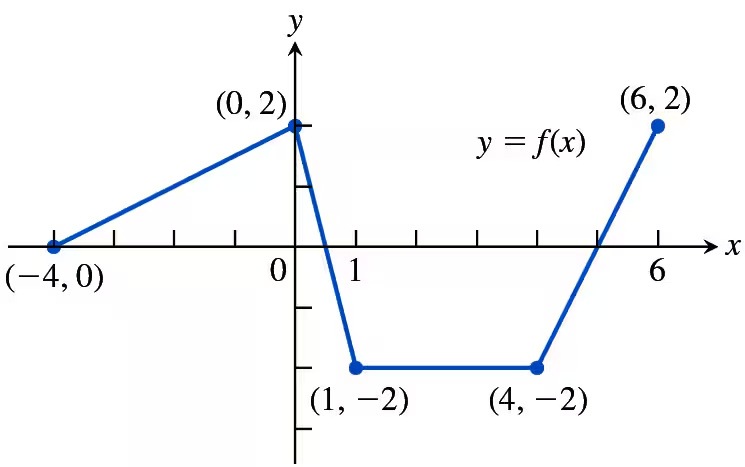
Consider the function f graphed here. The domain of f is the interval [−4, 6] and its graph is made of line segments joined end to end.


<IMAGE>


b. Graph the derivative of f. The graph should show a step function.

Guida verificata passo dopo passo
1
Step 1: Analyze the graph of f(x). The function is piecewise linear, composed of line segments joined end to end. The domain is [−4, 6], and the graph has vertices at (−4, 0), (0, 2), (1, −2), (4, −2), and (6, 2).
Step 2: Recall that the derivative of a function represents the slope of the tangent line at any given point. For a piecewise linear function, the derivative is constant within each segment since the slope does not change.
Step 3: Calculate the slope of each segment: - From (−4, 0) to (0, 2), the slope is \( \frac{2 - 0}{0 - (-4)} = \frac{2}{4} = \frac{1}{2} \). - From (0, 2) to (1, −2), the slope is \( \frac{-2 - 2}{1 - 0} = \frac{-4}{1} = -4 \). - From (1, −2) to (4, −2), the slope is \( \frac{-2 - (-2)}{4 - 1} = \frac{0}{3} = 0 \). - From (4, −2) to (6, 2), the slope is \( \frac{2 - (-2)}{6 - 4} = \frac{4}{2} = 2 \).
Step 4: Represent the derivative as a step function. The derivative is constant within each interval: - On [−4, 0], the derivative is \( \frac{1}{2} \). - On [0, 1], the derivative is −4. - On [1, 4], the derivative is 0. - On [4, 6], the derivative is 2.
Step 5: Sketch the graph of the derivative. The graph will be a step function with constant values: - A horizontal line at \( \frac{1}{2} \) from x = −4 to x = 0. - A horizontal line at −4 from x = 0 to x = 1. - A horizontal line at 0 from x = 1 to x = 4. - A horizontal line at 2 from x = 4 to x = 6.

Risposta video verificata per un problema simile:

Questa soluzione video è stata consigliata dai nostri tutor come utile per risolvere questo problema.
Durata del video:
4m

Concetti chiave

Ecco i concetti essenziali che devi comprendere per rispondere correttamente alla domanda.

Derivative of a Function

The derivative of a function at a point measures the rate at which the function value changes as its input changes. For a piecewise linear function, the derivative is constant on each segment, representing the slope of the line. In this graph, the derivative will be a step function, indicating constant slopes between the given points.
Video consigliato:
06:30
Derivatives of Other Trig Functions

Piecewise Linear Functions

A piecewise linear function is composed of straight line segments. Each segment has a constant slope, which is the derivative of the function over that interval. Understanding the slopes of these segments is crucial for graphing the derivative, as each segment's slope corresponds to a constant value in the derivative's graph.
Video consigliato:
Percorso guidato
05:36
Piecewise Functions

Step Functions

A step function is a piecewise function that jumps from one constant value to another at specific points. When graphing the derivative of a piecewise linear function, the result is a step function, where each step corresponds to the slope of a segment in the original function. This graph will have horizontal lines at the slope values, changing at the endpoints of each segment.
Video consigliato:
Percorso guidato
4:26
Evaluating Composed Functions
Pratica correlata
Domanda del libro di testo

Temperatures in Fairbanks, Alaska The graph in the accompanying figure shows the average Fahrenheit temperature in Fairbanks, Alaska, during a typical 365-day year. The equation that approximates the temperature on day x is


y = 37 sin[(2π/365)(x − 101)] + 25


and is graphed in the accompanying figure.


a. On what day is the temperature increasing the fastest?


" style="" width="420">

273
views
Domanda del libro di testo

By computing the first few derivatives and looking for a pattern, find the following derivatives.


a. d⁹⁹⁹/dx⁹⁹⁹ (cos x)

228
views
Domanda del libro di testo

Faster than a calculator Use the approximation (1 + x)ᵏ ≈ 1 + kx to estimate the following.


a. (1.0002)⁵⁰

208
views
Domanda del libro di testo

In Exercises 47 and 48, find an equation for


(b) the horizontal tangent line to the curve at Q.


" style="" width="200">

313
views
Domanda del libro di testo

Fruit flies (Continuation of Example 4, Section 2.1.) Populations starting out in closed environments grow slowly at first, when there are relatively few members, then more rapidly as the number of reproducing individuals increases and resources are still abundant, then slowly again as the population reaches the carrying capacity of the environment.


b. During what days does the population seem to be increasing fastest? Slowest?


240
views
Domanda del libro di testo

The folium of Descartes (See Figure 3.27)


b. At what point other than the origin does the folium have a horizontal tangent line?


242
views