Ch. 3 - Derivatives
Hass - Thomas' Calculus 15th Edition
Hass15th EditionThomas' CalculusISBN: 9780137616077Non è quello che usi tu?Cambia libro di testo
Capitolo 3, Problema 3.6.86a

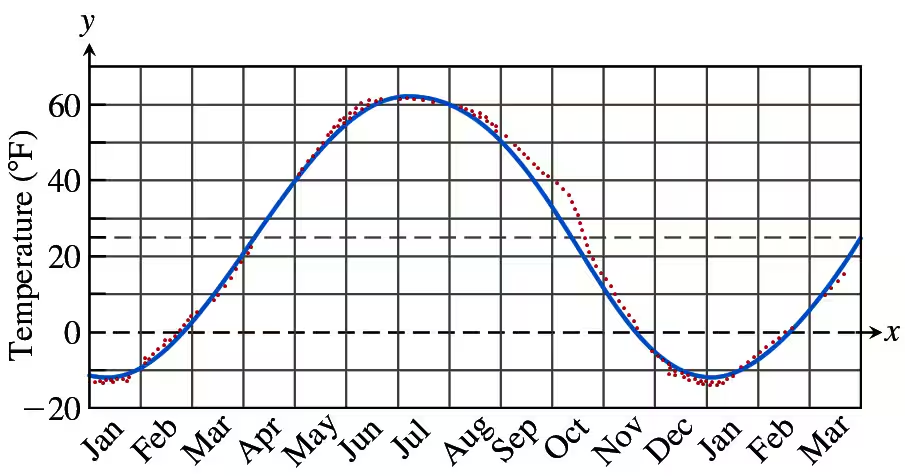
Temperatures in Fairbanks, Alaska The graph in the accompanying figure shows the average Fahrenheit temperature in Fairbanks, Alaska, during a typical 365-day year. The equation that approximates the temperature on day x is


y = 37 sin[(2π/365)(x − 101)] + 25


and is graphed in the accompanying figure.


a. On what day is the temperature increasing the fastest?


<IMAGE>

Guida verificata passo dopo passo
1
Step 1: To determine the day when the temperature is increasing the fastest, we need to find the derivative of the given temperature function y = 37 sin[(2π/365)(x − 101)] + 25. The derivative represents the rate of change of temperature with respect to time (day x).
Step 2: Differentiate the function y with respect to x. Using the chain rule, the derivative of y = 37 sin[(2π/365)(x − 101)] + 25 is given by dy/dx = 37 * cos[(2π/365)(x − 101)] * (2π/365). The constant 25 disappears because its derivative is zero.
Step 3: Simplify the derivative expression to dy/dx = (74π/365) * cos[(2π/365)(x − 101)]. This represents the rate of change of temperature on day x.
Step 4: To find the day when the temperature is increasing the fastest, we need to maximize dy/dx. The cosine function achieves its maximum value of 1 when its argument is zero. Set (2π/365)(x − 101) = 0 and solve for x to find the day.
Step 5: Solve for x: x = 101. This indicates that the temperature is increasing the fastest on day 101 of the year, which corresponds to a date in early April based on the graph.

Risposta video verificata per un problema simile:

Questa soluzione video è stata consigliata dai nostri tutor come utile per risolvere questo problema.
Durata del video:
7m

Concetti chiave

Ecco i concetti essenziali che devi comprendere per rispondere correttamente alla domanda.

Derivative and Rate of Change

The derivative of a function at a point gives the rate of change of the function at that point. In the context of the temperature function, the derivative represents how quickly the temperature is changing on a given day. To find when the temperature is increasing the fastest, we need to identify the point where the derivative of the temperature function is at its maximum.
Video consigliato:
Percorso guidato
04:16
Intro To Related Rates

Sine Function and its Properties

The sine function is a periodic function that oscillates between -1 and 1. In the given temperature equation, the sine function models the cyclical nature of temperature changes over the year. Understanding the properties of the sine function, such as its amplitude, period, and phase shift, is crucial for analyzing how the temperature varies throughout the year.
Video consigliato:
Percorso guidato
06:21
Properties of Functions

Chain Rule for Differentiation

The chain rule is a fundamental technique in calculus used to differentiate composite functions. In the temperature equation, the sine function is composed with a linear function of x. Applying the chain rule allows us to differentiate the temperature function with respect to x, which is necessary to find the rate of change of temperature and determine when it is increasing the fastest.
Video consigliato:
05:02
Intro to the Chain Rule