Ch. 3 - Derivatives
Hass - Thomas' Calculus 15th Edition
Hass15th EditionThomas' CalculusISBN: 9780137616077Non è quello che usi tu?Cambia libro di testo
Capitolo 3, Problema 3.3.12

Derivative Calculations


In Exercises 1–12, find the first and second derivatives.


r = 12/θ − 4/θ³ + 1/θ⁴

Guida verificata passo dopo passo
1
Step 1: Identify the function for which you need to find the derivatives. The function given is \( r(\theta) = \frac{12}{\theta} - \frac{4}{\theta^3} + \frac{1}{\theta^4} \).
Step 2: Rewrite the function in terms of powers of \( \theta \) to make differentiation easier. This gives \( r(\theta) = 12\theta^{-1} - 4\theta^{-3} + \theta^{-4} \).
Step 3: Find the first derivative \( r'(\theta) \) by applying the power rule \( \frac{d}{d\theta}[\theta^n] = n\theta^{n-1} \) to each term. Differentiate each term separately.
Step 4: Find the second derivative \( r''(\theta) \) by differentiating \( r'(\theta) \) using the power rule again. Apply the rule to each term of the first derivative.
Step 5: Simplify the expressions for both the first and second derivatives to obtain the final forms. Ensure all terms are expressed in terms of \( \theta \) with negative exponents as needed.

Risposta video verificata per un problema simile:

Questa soluzione video è stata consigliata dai nostri tutor come utile per risolvere questo problema.
Durata del video:
3m

Concetti chiave

Ecco i concetti essenziali che devi comprendere per rispondere correttamente alla domanda.

Derivatives

A derivative represents the rate of change of a function with respect to a variable. In calculus, it is a fundamental concept that allows us to determine how a function behaves locally. The first derivative indicates the slope of the tangent line to the curve at any point, while the second derivative provides information about the curvature or concavity of the function.
Video consigliato:

Chain Rule

The chain rule is a formula for computing the derivative of a composite function. It states that if a function y is composed of two functions u and x (i.e., y = f(u) and u = g(x)), then the derivative of y with respect to x is the product of the derivative of f with respect to u and the derivative of g with respect to x. This rule is essential when differentiating functions that involve variables in the denominator, as seen in the given expression.
Video consigliato:
05:02
Intro to the Chain Rule

Power Rule

The power rule is a basic technique for finding the derivative of a function in the form of x^n, where n is any real number. According to this rule, the derivative of x^n is n*x^(n-1). This rule simplifies the process of differentiation, especially for polynomial and rational functions, making it crucial for calculating the first and second derivatives of the given function.
Video consigliato:
5:50
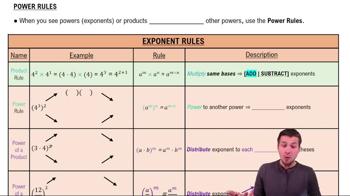
Power Rules