Ch. 3 - Derivatives
Hass - Thomas' Calculus 15th Edition
Hass15th EditionThomas' CalculusISBN: 9780137616077Non è quello che usi tu?Cambia libro di testo
Capitolo 3, Problema 3.35

Find the derivatives of the functions in Exercises 1–42.


𝓻 = ( sin θ )²
( cos θ - 1 )

Guida verificata passo dopo passo
1
Identify the function for which you need to find the derivative. Here, the function is \( r(\theta) = (\sin \theta)^2 (\cos \theta - 1) \).
Apply the product rule for differentiation, which states that if you have a function \( u(\theta) \cdot v(\theta) \), its derivative is \( u'(\theta) \cdot v(\theta) + u(\theta) \cdot v'(\theta) \). In this case, let \( u(\theta) = (\sin \theta)^2 \) and \( v(\theta) = (\cos \theta - 1) \).
Differentiate \( u(\theta) = (\sin \theta)^2 \) using the chain rule. The chain rule states that the derivative of \( (f(g(\theta))) \) is \( f'(g(\theta)) \cdot g'(\theta) \). Here, \( f(x) = x^2 \) and \( g(\theta) = \sin \theta \). So, \( u'(\theta) = 2 \sin \theta \cdot \cos \theta \).
Differentiate \( v(\theta) = (\cos \theta - 1) \). The derivative of \( \cos \theta \) is \( -\sin \theta \), and the derivative of a constant is 0. Therefore, \( v'(\theta) = -\sin \theta \).
Substitute \( u'(\theta) \), \( u(\theta) \), \( v'(\theta) \), and \( v(\theta) \) into the product rule formula: \( r'(\theta) = [2 \sin \theta \cdot \cos \theta] \cdot (\cos \theta - 1) + (\sin \theta)^2 \cdot [-\sin \theta] \). Simplify the expression to find the derivative.

Risposta video verificata per un problema simile:

Questa soluzione video è stata consigliata dai nostri tutor come utile per risolvere questo problema.
Durata del video:
3m

Concetti chiave

Ecco i concetti essenziali che devi comprendere per rispondere correttamente alla domanda.

Derivatives

A derivative represents the rate at which a function changes at any given point. It is a fundamental concept in calculus that provides information about the slope of the tangent line to the curve of the function. Derivatives can be computed using various rules, such as the power rule, product rule, and chain rule, depending on the form of the function.
Video consigliato:

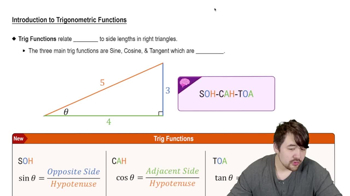
Trigonometric Functions

Trigonometric functions, such as sine and cosine, are periodic functions that relate angles to ratios of sides in right triangles. In calculus, these functions are essential for modeling oscillatory behavior and are frequently encountered in derivatives. Understanding their properties, such as their derivatives (e.g., the derivative of sin θ is cos θ), is crucial for solving problems involving these functions.
Video consigliato:
Percorso guidato
6:04
Introduction to Trigonometric Functions

Polar Coordinates

Polar coordinates provide a way to represent points in a plane using a distance from a reference point and an angle from a reference direction. In the context of the given function, r = (sin θ)² / (cos θ - 1), understanding how to differentiate functions expressed in polar coordinates is important. The conversion between polar and Cartesian coordinates may also be necessary for certain derivative calculations.
Video consigliato:
06:10
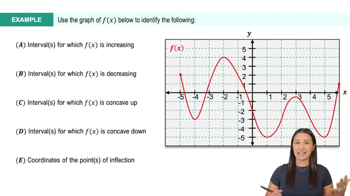
Determining Concavity from the Graph of f' or f'' Example 1