
Ch. 3 - Derivatives
Hass - Thomas' Calculus 15th Edition
Hass15th EditionThomas' CalculusISBN: 9780137616077Non è quello che usi tu?Cambia libro di testo
Capitolo 3, Problema 3.2.45a

Differentiability and Continuity on an Interval


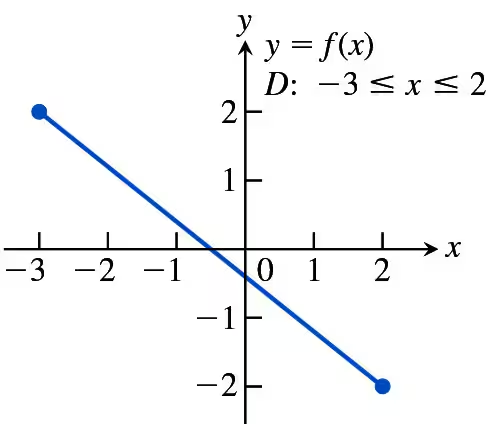
Each figure in Exercises 45–50 shows the graph of a function over a closed interval D. At what domain points does the function appear to be


a. differentiable?


Give reasons for your answers.
Graph of a linear function with endpoints at (-3, 2) and (2, -2) over the interval from -3 to 2 on a coordinate plane.

Guida verificata passo dopo passo
1
Examine the graph of the function over the interval D: [-3, 2]. The function is represented by a straight line, which suggests it is a linear function.
Recall that a function is differentiable at a point if it is continuous at that point and has a defined derivative there. Linear functions are differentiable everywhere on their domain.
Check the endpoints of the interval, x = -3 and x = 2. At x = -3, the function is continuous and the derivative exists because the line extends smoothly from this point. At x = 2, the function is also continuous and the derivative exists as the line ends smoothly.
Since the function is a straight line, it is differentiable at every point in the interval D: [-3, 2]. There are no corners, cusps, or vertical tangents that would make the function non-differentiable at any point.
Conclude that the function is differentiable at all points in the domain D: [-3, 2] because it is a linear function, which is inherently differentiable across its entire domain.

Risposta video verificata per un problema simile:

Questa soluzione video è stata consigliata dai nostri tutor come utile per risolvere questo problema.
Durata del video:
1m

Concetti chiave

Ecco i concetti essenziali che devi comprendere per rispondere correttamente alla domanda.

Differentiability

A function is differentiable at a point if it has a defined derivative at that point, meaning the function's graph has a tangent line that is well-defined. This requires the function to be continuous at that point and for the left-hand and right-hand derivatives to be equal. Points where the graph has sharp corners, vertical tangents, or discontinuities indicate non-differentiability.
Video consigliato:
Percorso guidato
05:53
Finding Differentials

Continuity

A function is continuous at a point if the limit of the function as it approaches that point equals the function's value at that point. This means there are no breaks, jumps, or holes in the graph at that point. For a function to be continuous over an interval, it must be continuous at every point within that interval.
Video consigliato:
05:34
Intro to Continuity

Closed Interval

A closed interval, denoted as [a, b], includes all numbers between a and b, as well as the endpoints a and b themselves. In the context of calculus, analyzing functions over closed intervals is important for determining properties like continuity and differentiability at the endpoints, which can behave differently than points within the interval.
Video consigliato:
Percorso guidato
11:11
Improper Integrals: Infinite Intervals