Ch. 3 - Derivatives
Hass - Thomas' Calculus 15th Edition
Hass15th EditionThomas' CalculusISBN: 9780137616077Non è quello che usi tu?Cambia libro di testo
Capitolo 3, Problema 3.2.46a

Differentiability and Continuity on an Interval


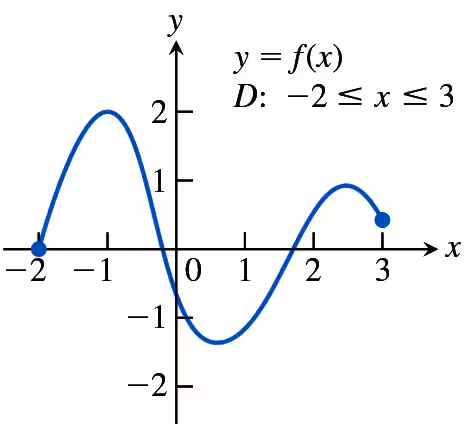
Each figure in Exercises 45–50 shows the graph of a function over a closed interval D. At what domain points does the function appear to be


a. differentiable?


Give reasons for your answers.
Graph of a function showing its behavior over the interval from -2 to 3, highlighting points of differentiability.

Guida verificata passo dopo passo
1
Examine the graph of the function over the interval [-2, 3]. Differentiability requires the function to be smooth and continuous without any sharp corners or vertical tangents.
Identify points where the function is not continuous. In this graph, the function appears continuous over the entire interval [-2, 3], as there are no breaks or jumps.
Look for points where the function has sharp corners or cusps. These are points where the function is not differentiable. In this graph, there are no visible sharp corners or cusps.
Check for vertical tangents, which indicate non-differentiability. The graph does not show any vertical tangents, suggesting differentiability at all points.
Consider the endpoints of the interval. At x = -2 and x = 3, the function is continuous, but differentiability at endpoints depends on the behavior of the function approaching these points. Since the graph is smooth at these endpoints, the function appears differentiable at all points in the interval [-2, 3].

Risposta video verificata per un problema simile:

Questa soluzione video è stata consigliata dai nostri tutor come utile per risolvere questo problema.
Durata del video:
1m

Concetti chiave

Ecco i concetti essenziali che devi comprendere per rispondere correttamente alla domanda.

Differentiability

A function is differentiable at a point if it has a defined derivative there, meaning the function's graph has a tangent line at that point. This requires the function to be continuous at that point and for the slope of the tangent to be consistent from both sides. Points where the graph has sharp corners, vertical tangents, or discontinuities indicate non-differentiability.
Video consigliato:
Percorso guidato
05:53
Finding Differentials

Continuity

A function is continuous at a point if the limit of the function as it approaches that point equals the function's value at that point. This means there are no breaks, jumps, or holes in the graph at that point. For a function to be differentiable, it must first be continuous; however, continuity alone does not guarantee differentiability.
Video consigliato:
05:34
Intro to Continuity

Critical Points

Critical points of a function occur where its derivative is zero or undefined. These points are significant because they can indicate local maxima, minima, or points of inflection. In the context of differentiability, critical points can help identify where the function may not be smooth or where the behavior of the function changes, thus affecting its differentiability.
Video consigliato:
04:50
Critical Points