
Ch. 4 - Applications of Derivatives
Hass - Thomas' Calculus 15th Edition
Hass15th EditionThomas' CalculusISBN: 9780137616077Non è quello che usi tu?Cambia libro di testo
Capitolo 4, Problema 4.7.67

Checking Antiderivative Formulas


Right, or wrong? Give a brief reason why.


∫−15(x + 3)² / (x − 2)⁴ dx = ((x + 3)/(x − 2))³ + C

Guida verificata passo dopo passo
1
Identify the given integral: \(\int -15 \frac{(x + 3)^2}{(x - 2)^4} \, dx\) and the proposed antiderivative: \(\left( \frac{x + 3}{x - 2} \right)^3 + C\).
To verify if the proposed antiderivative is correct, differentiate \(\left( \frac{x + 3}{x - 2} \right)^3\) using the chain rule.
Let \(u = \frac{x + 3}{x - 2}\). Then the derivative of \(u^3\) with respect to \(x\) is \(3u^2 \cdot \frac{du}{dx}\).
Find \(\frac{du}{dx}\) by applying the quotient rule: \(\frac{d}{dx} \left( \frac{x + 3}{x - 2} \right) = \frac{(1)(x - 2) - (x + 3)(1)}{(x - 2)^2} = \frac{x - 2 - x - 3}{(x - 2)^2} = \frac{-5}{(x - 2)^2}\).
Combine these results: \(\frac{d}{dx} \left( \frac{x + 3}{x - 2} \right)^3 = 3 \left( \frac{x + 3}{x - 2} \right)^2 \cdot \left( \frac{-5}{(x - 2)^2} \right) = -15 \frac{(x + 3)^2}{(x - 2)^4}\), which matches the integrand, confirming the antiderivative is correct.

Risposta video verificata per un problema simile:

Questa soluzione video è stata consigliata dai nostri tutor come utile per risolvere questo problema.
Durata del video:
4m

Concetti chiave

Ecco i concetti essenziali che devi comprendere per rispondere correttamente alla domanda.

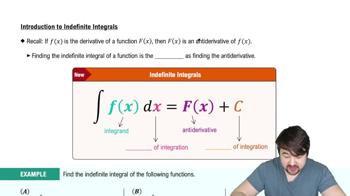
Antiderivative and Indefinite Integration

An antiderivative of a function is another function whose derivative equals the original function. Indefinite integration finds all antiderivatives and includes a constant of integration (C) because differentiation loses constant terms. Verifying an antiderivative involves differentiating the proposed solution and checking if it matches the original integrand.
Video consigliato:
Percorso guidato
05:04
Introduction to Indefinite Integrals

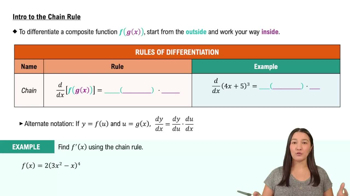
Chain Rule and Power Rule in Differentiation

The chain rule is used to differentiate composite functions, applying the derivative of the outer function multiplied by the derivative of the inner function. The power rule states that d/dx[x^n] = n*x^(n-1). Understanding these rules is essential to verify if the given antiderivative is correct by differentiating it properly.
Video consigliato:
05:02
Intro to the Chain Rule

Algebraic Manipulation of Rational Functions

Rational functions are ratios of polynomials, and simplifying or rewriting them can help in integration or differentiation. Recognizing how to express the integrand and the proposed antiderivative in comparable forms is crucial to verify correctness, especially when powers and sums are involved in numerator and denominator.
Video consigliato:
06:11
Limits of Rational Functions: Denominator = 0
Pratica correlata
Domanda del libro di testo

Identifying Extrema


In Exercises 19–40:


a. Find the open intervals on which the function is increasing and those on which it is decreasing.


b. Identify the function’s local extreme values, if any, saying where they occur.


f(x) = (x² − 3) / (x − 2), x ≠ 2

187
views
Domanda del libro di testo

Checking the Mean Value Theorem


Which of the functions in Exercises 7–12 satisfy the hypotheses of the Mean Value Theorem on the given interval, and which do not? Give reasons for your answers.


f(x) = √(x(1 − x)), [0, 1]

188
views
Domanda del libro di testo

In Exercises 9–66, graph the function using appropriate methods from the graphing procedures presented just before Example 9, identifying the coordinates of any local extreme points and inflection points. Then find coordinates of absolute extreme points, if any.

53. y = x * √(8 - x²)

175
views
Domanda del libro di testo

Business and Economics

60. Production level Prove that the production level (if any) at which average cost is smallest is a level at which the average cost equals marginal cost.

229
views
Domanda del libro di testo

Roots (Zeros)


Show that the functions in Exercises 19–26 have exactly one zero in the given interval.


g(t) = √t + √(1 + t) − 4, (0, ∞)

176
views
Domanda del libro di testo

93. The accompanying figure shows a portion of the graph of a twice-differentiable function y=f(x). At each of the five labeled points, classify y' and \(\y\)'' as positive, negative, or zero.

" style="" width="254">

236
views