Ch. 4 - Applications of Derivatives
Hass - Thomas' Calculus 15th Edition
Hass15th EditionThomas' CalculusISBN: 9780137616077Non è quello che usi tu?Cambia libro di testo
Capitolo 4, Problema 4.2.9

Checking the Mean Value Theorem


Which of the functions in Exercises 7–12 satisfy the hypotheses of the Mean Value Theorem on the given interval, and which do not? Give reasons for your answers.


f(x) = √(x(1 − x)), [0, 1]

Guida verificata passo dopo passo
1
Step 1: Recall the Mean Value Theorem (MVT), which states that if a function f is continuous on the closed interval [a, b] and differentiable on the open interval (a, b), then there exists at least one c in (a, b) such that f'(c) = (f(b) - f(a)) / (b - a).
Step 2: Check the continuity of f(x) = √(x(1 − x)) on the interval [0, 1]. Since the square root function and polynomial functions are continuous, and the composition of continuous functions is continuous, f(x) is continuous on [0, 1].
Step 3: Check the differentiability of f(x) on the open interval (0, 1). The function f(x) = √(x(1 − x)) can be rewritten as (x(1 − x))^(1/2). To check differentiability, we need to find the derivative f'(x) and ensure it exists for all x in (0, 1).
Step 4: Differentiate f(x) using the chain rule. Let u = x(1 − x), then f(x) = u^(1/2). The derivative f'(x) = (1/2)u^(-1/2) * du/dx. Calculate du/dx = 1 - 2x, so f'(x) = (1/2)(x(1 − x))^(-1/2) * (1 - 2x).
Step 5: Verify that f'(x) exists for all x in (0, 1). Since the expression (x(1 − x))^(-1/2) is defined and finite for x in (0, 1), f'(x) is well-defined and differentiable on (0, 1). Therefore, f(x) satisfies the hypotheses of the Mean Value Theorem on the interval [0, 1].

Risposta video verificata per un problema simile:

Questa soluzione video è stata consigliata dai nostri tutor come utile per risolvere questo problema.
Durata del video:
6m

Concetti chiave

Ecco i concetti essenziali che devi comprendere per rispondere correttamente alla domanda.

Mean Value Theorem

The Mean Value Theorem states that for a function f that is continuous on a closed interval [a, b] and differentiable on the open interval (a, b), there exists at least one point c in (a, b) such that f'(c) = (f(b) - f(a)) / (b - a). This theorem connects the average rate of change of the function over the interval to the instantaneous rate of change at some point within the interval.
Video consigliato:
Percorso guidato
06:11
Fundamental Theorem of Calculus Part 1

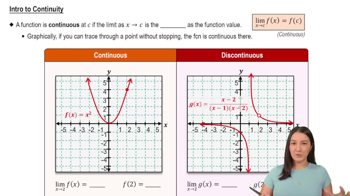
Continuity

Continuity of a function on a closed interval [a, b] means that the function does not have any breaks, jumps, or holes in the interval. For the Mean Value Theorem to apply, the function must be continuous on [a, b]. In the given function f(x) = √(x(1 − x)), we need to check if it is continuous on [0, 1] by ensuring the expression under the square root is non-negative throughout the interval.
Video consigliato:
05:34
Intro to Continuity

Differentiability

Differentiability refers to the existence of a derivative at each point in an open interval (a, b). A function is differentiable if it has a defined slope at every point in the interval. For the function f(x) = √(x(1 − x)), we must verify that it is differentiable on (0, 1) by checking if the derivative exists and is continuous throughout this interval, ensuring no sharp corners or vertical tangents.
Video consigliato:
Percorso guidato
05:53
Finding Differentials