
Ch. 4 - Applications of Derivatives
Hass - Thomas' Calculus 15th Edition
Hass15th EditionThomas' CalculusISBN: 9780137616077Non è quello che usi tu?Cambia libro di testo
Capitolo 4, Problema 4.3.5b

Analyzing Functions from Derivatives


Answer the following questions about the functions whose derivatives are given in Exercises 1–14:


b. On what open intervals is f increasing or decreasing?


f′(x) = (x − 1)(x + 2)(x − 3)

Guida verificata passo dopo passo
1
First, identify the critical points of the function f by setting the derivative f'(x) = (x - 1)(x + 2)(x - 3) equal to zero. Solve the equation (x - 1)(x + 2)(x - 3) = 0 to find the values of x where the derivative is zero.
The solutions to the equation are x = 1, x = -2, and x = 3. These are the critical points where the function f could change from increasing to decreasing or vice versa.
Next, determine the sign of f'(x) in the intervals defined by the critical points: (-∞, -2), (-2, 1), (1, 3), and (3, ∞). Choose test points from each interval and substitute them into f'(x) to check whether the derivative is positive or negative.
For each interval, if f'(x) is positive, the function f is increasing in that interval. If f'(x) is negative, the function f is decreasing in that interval.
Summarize the intervals where f is increasing and decreasing based on the sign of f'(x) in each interval. This will give you the open intervals where the function f is increasing or decreasing.

Risposta video verificata per un problema simile:

Questa soluzione video è stata consigliata dai nostri tutor come utile per risolvere questo problema.
Durata del video:
6m

Concetti chiave

Ecco i concetti essenziali che devi comprendere per rispondere correttamente alla domanda.

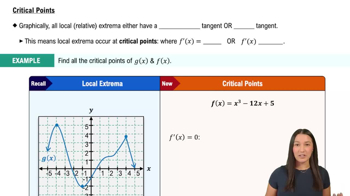
Critical Points

Critical points of a function occur where its derivative is zero or undefined. These points are essential for determining where a function changes from increasing to decreasing or vice versa. In the given derivative f′(x) = (x − 1)(x + 2)(x − 3), the critical points are x = 1, x = -2, and x = 3, where the derivative equals zero.
Video consigliato:
04:50
Critical Points

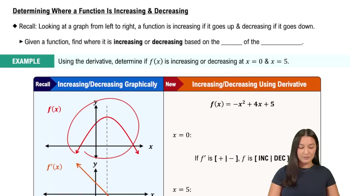
Increasing and Decreasing Intervals

A function is increasing on intervals where its derivative is positive and decreasing where its derivative is negative. By analyzing the sign of f′(x) = (x − 1)(x + 2)(x − 3) across different intervals determined by the critical points, we can determine where the function f is increasing or decreasing.
Video consigliato:
07:32
Determining Where a Function is Increasing & Decreasing

Sign Chart Analysis

A sign chart helps visualize the sign changes of a derivative across different intervals. By testing points in each interval created by the critical points, we can determine the sign of the derivative in those intervals. This analysis helps identify where the function is increasing or decreasing, based on whether the derivative is positive or negative.
Video consigliato:
Percorso guidato
06:51
Derivatives Applied To Acceleration Example 2