
Ch. 4 - Applications of Derivatives
Hass - Thomas' Calculus 15th Edition
Hass15th EditionThomas' CalculusISBN: 9780137616077Non è quello che usi tu?Cambia libro di testo
Capitolo 4, Problema 16

In Exercises 9–66, graph the function using appropriate methods from the graphing procedures presented just before Example 9, identifying the coordinates of any local extreme points and inflection points. Then find coordinates of absolute extreme points, if any.
y=1-(x+1)^3

Guida verificata passo dopo passo
1
Identify the function: The given function is \( y = 1 - (x+1)^3 \). This is a cubic function, which typically has an S-shaped curve.
Find the first derivative: To locate local extreme points, calculate the first derivative \( y' \) of the function. Use the power rule to differentiate: \( y' = -3(x+1)^2 \).
Set the first derivative to zero to find critical points: Solve \( -3(x+1)^2 = 0 \). This gives \( x = -1 \) as the critical point.
Determine the nature of the critical point: Use the second derivative test. Find the second derivative \( y'' = -6(x+1) \). Evaluate \( y''(-1) \) to determine if the critical point is a local maximum, minimum, or neither.
Find inflection points: Set the second derivative \( y'' = -6(x+1) \) to zero and solve for \( x \). This gives \( x = -1 \) as a potential inflection point. Check the sign change of \( y'' \) around \( x = -1 \) to confirm.

Risposta video verificata per un problema simile:

Questa soluzione video è stata consigliata dai nostri tutor come utile per risolvere questo problema.
Durata del video:
6m

Concetti chiave

Ecco i concetti essenziali che devi comprendere per rispondere correttamente alla domanda.

Graphing Functions

Graphing functions involves plotting the curve of a function on a coordinate plane to visualize its behavior. This includes identifying key features such as intercepts, asymptotes, and the overall shape of the graph. For the function y = 1 - (x+1)^3, understanding how transformations affect the graph is crucial, such as shifts and reflections.
Video consigliato:
Percorso guidato
5:53
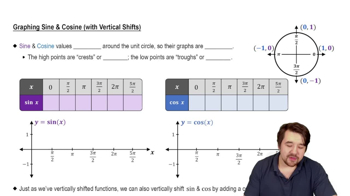
Graph of Sine and Cosine Function

Local Extreme Points

Local extreme points are points where a function reaches a local maximum or minimum within a certain interval. These are found by analyzing the derivative of the function, setting it to zero, and solving for x. For y = 1 - (x+1)^3, finding the derivative will help identify where the slope changes, indicating potential local maxima or minima.
Video consigliato:
04:50
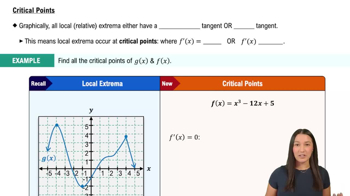
Critical Points

Inflection Points

Inflection points occur where the curvature of the graph changes, which is determined by the second derivative of the function. An inflection point is where the second derivative equals zero and changes sign. For y = 1 - (x+1)^3, calculating the second derivative will reveal points where the graph transitions from concave up to concave down or vice versa.
Video consigliato:
04:50
Critical Points
Pratica correlata
Domanda del libro di testo

As a result of a heavy rain, the volume of water in a reservoir increased by 1400 acre-ft in 24 hours. Show that at some instant during that period the reservoir’s volume was increasing at a rate in excess of 225,000 gal/min. (An acre-foot is 43,560 ft³, the volume that would cover 1 acre to the depth of 1 ft. A cubic foot holds 7.48 gal.) 

229
views
Domanda del libro di testo

Theory and Examples


In Exercises 51 and 52, give reasons for your answers.


Let f(x) = |x³ − 9x|.


d. Determine all extrema of f.

170
views
Domanda del libro di testo

Applications


Suppose that f(x) = d/dx (1 − √x) and g(x) = d/dx (x + 2).


Find:


∫[f(x) + g(x)] dx

24
views
Domanda del libro di testo

In Exercises 9–66, graph the function using appropriate methods from the graphing procedures presented just before Example 9, identifying the coordinates of any local extreme points and inflection points. Then find coordinates of absolute extreme points, if any.

y = (x² - 49) / (x² + 5x - 14)

111
views
Domanda del libro di testo

The Mean Value Theorem                                                                                                                                                                  


 a. Show that the equation 𝓍⁴ + 2𝓍² ― 2 = 0 has exactly one solution on [0,1] .


[Technology Exercises] b.Find the solution to as many decimal places as you can.  

277
views
Domanda del libro di testo

106. Motion Along a Line The graphs in Exercises 105 and 106 show the position s=f(t) of an object moving up and down on a coordinate line. At approximately what times is the (d) When is the acceleration positive? Negative?

217
views