Ch. 4 - Applications of Derivatives
Hass - Thomas' Calculus 15th Edition
Hass15th EditionThomas' CalculusISBN: 9780137616077Non è quello che usi tu?Cambia libro di testo
Capitolo 4, Problema 4.5.45

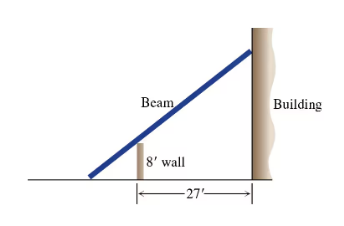
The 8-ft wall shown here stands 27 ft from the building. Find the length of the shortest straight beam that will reach to the side of the building from the ground outside the wall.
beam

Guida verificata passo dopo passo
1
Visualize the problem as a right triangle where the beam is the hypotenuse, the wall is one leg, and the distance from the wall to the building is the other leg.
Let the point where the beam touches the wall be (x, 8) and the point where it touches the building be (27, y). The beam forms a right triangle with the ground and the wall.
The length of the beam can be expressed using the Pythagorean theorem: \( L = \sqrt{x^2 + (y - 8)^2} \).
To minimize the length of the beam, we need to express y in terms of x using the similar triangles formed by the beam, wall, and building. The ratio of the sides of the triangles gives us \( \frac{y}{x} = \frac{y - 8}{27} \).
Solve the equation \( \frac{y}{x} = \frac{y - 8}{27} \) for y, substitute back into the expression for L, and find the minimum value of L using calculus by taking the derivative and setting it to zero.

Risposta video verificata per un problema simile:

Questa soluzione video è stata consigliata dai nostri tutor come utile per risolvere questo problema.
Durata del video:
11m

Concetti chiave

Ecco i concetti essenziali che devi comprendere per rispondere correttamente alla domanda.

Pythagorean Theorem

The Pythagorean Theorem states that in a right triangle, the square of the length of the hypotenuse (the side opposite the right angle) is equal to the sum of the squares of the lengths of the other two sides. This theorem is essential for calculating the length of the beam, as it forms a right triangle with the wall and the distance from the wall to the building.
Video consigliato:
Percorso guidato
06:11
Fundamental Theorem of Calculus Part 1

Optimization

Optimization in calculus involves finding the maximum or minimum values of a function. In this problem, we need to minimize the length of the beam, which can be modeled as a function of the height at which it touches the building. Understanding how to set up and solve optimization problems is crucial for finding the shortest beam.
Video consigliato:
10:13
Intro to Applied Optimization: Maximizing Area

Related Rates

Related rates are used in calculus to find the rate at which one quantity changes in relation to another. In this scenario, as the height of the beam changes, the length of the beam also changes. Understanding how to relate these rates will help in deriving the function that describes the beam's length in terms of its height.
Video consigliato:
Percorso guidato
04:16
Intro To Related Rates
Pratica correlata
Domanda del libro di testo

Theory and Examples


Maximum height of a vertically moving body The height of a body moving vertically is given by s = −12gt² + υ₀t + s₀,  g > 0, with s in meters and t in seconds. Find the body’s maximum height.

209
views

Domanda del libro di testo

Finding Indefinite Integrals


In Exercises 17–56, find the most general antiderivative or indefinite integral. You may need to try a solution and then adjust your guess. Check your answers by differentiation.


∫(cscθ cotθ) / 2 dθ

20
views
Domanda del libro di testo

Business and Economics

62. Production level Suppose that c(x)=x^3-20x^2 + 20,000x is the cost of manufacturing x items. Find a production level that will minimize the average cost of making x items.

182
views
Domanda del libro di testo

56. Airplane landing path An airplane is flying at altitude H when it begins its descent to an airport runway that is at horizontal ground distance L from the airplane, as shown in the accompanying figure. Assume that the landing path of the airplane is the graph of a cubic polynomial function y = ax^3+bx^2+cx+d, where y(-L)= H and y(0)=0.

a. What is dy/dx at x = 0?

b. What is dy/dx at x = -L?

c. Use the values for dy/dx at x = 0 and x =- L together with y(0) = 0 and y(-L) = H to show that y(x)=H[2(x/L)^3+3(x/L)^2]

158
views
Domanda del libro di testo

Absolute Extrema on Finite Closed Intervals


In Exercises 21–36, find the absolute maximum and minimum values of each function on the given interval. Then graph the function. Identify the points on the graph where the absolute extrema occur, and include their coordinates.


g(x) = √(4 − x²), −2 ≤ x ≤ 1

305
views
Domanda del libro di testo

Checking Antiderivative Formulas


Verify the formulas in Exercises 57–62 by differentiation.


∫csc²((x − 1)/3)dx = −3cot((x − 1)/3) + C

37
views