

Ch. 4 - Applications of Derivatives
Hass - Thomas' Calculus 15th Edition
Hass15th EditionThomas' CalculusISBN: 9780137616077Non è quello che usi tu?Cambia libro di testo
Capitolo 4, Problema 4.1.61

Theory and Examples


Maximum height of a vertically moving body The height of a body moving vertically is given by s = −12gt² + υ₀t + s₀,  g > 0, with s in meters and t in seconds. Find the body’s maximum height.

Guida verificata passo dopo passo
1
Identify the given equation for the height of the body: \( s(t) = -12gt^2 + v_0t + s_0 \), where \( g \) is the acceleration due to gravity, \( v_0 \) is the initial velocity, and \( s_0 \) is the initial height.
To find the maximum height, we need to determine the time \( t \) at which the velocity is zero. The velocity \( v(t) \) is the derivative of the height function \( s(t) \) with respect to time \( t \).
Differentiate the height function: \( v(t) = \frac{d}{dt}(-12gt^2 + v_0t + s_0) = -24gt + v_0 \).
Set the velocity \( v(t) \) to zero to find the critical point: \( -24gt + v_0 = 0 \). Solve for \( t \) to find \( t = \frac{v_0}{24g} \).
Substitute \( t = \frac{v_0}{24g} \) back into the original height equation \( s(t) \) to find the maximum height: \( s_{max} = -12g\left(\frac{v_0}{24g}\right)^2 + v_0\left(\frac{v_0}{24g}\right) + s_0 \). Simplify this expression to find the maximum height.

Risposta video verificata per un problema simile:

Questa soluzione video è stata consigliata dai nostri tutor come utile per risolvere questo problema.
Durata del video:
4m

Concetti chiave

Ecco i concetti essenziali che devi comprendere per rispondere correttamente alla domanda.

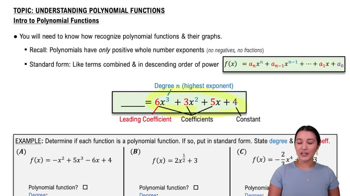
Quadratic Functions

A quadratic function is a polynomial of degree two, typically in the form of ax² + bx + c. The graph of a quadratic function is a parabola, which can open upwards or downwards. In the context of the problem, the height function s = −12gt² + υ₀t + s₀ is a quadratic function of time t, where the coefficient of t² determines the direction of the parabola.
Video consigliato:
6:04
Introduction to Polynomial Functions

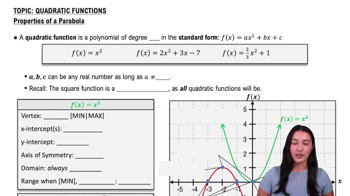
Vertex of a Parabola

The vertex of a parabola is the point where it reaches its maximum or minimum value. For a quadratic function in the form ax² + bx + c, the vertex can be found using the formula t = -b/(2a). In this problem, the vertex represents the time at which the body reaches its maximum height, as the parabola opens downwards due to the negative coefficient of t².
Video consigliato:
7:42
Properties of Parabolas

Derivative and Critical Points

The derivative of a function gives the rate of change and can be used to find critical points where the function's slope is zero. These points are potential maxima or minima. For the height function, taking the derivative with respect to time and setting it to zero helps find the time at which the maximum height occurs, confirming the vertex calculation.
Video consigliato:
04:50
Critical Points