Ch. 4 - Applications of Derivatives
Hass - Thomas' Calculus 15th Edition
Hass15th EditionThomas' CalculusISBN: 9780137616077Non è quello che usi tu?Cambia libro di testo
Capitolo 4, Problema 4.1.52b

Theory and Examples


In Exercises 51 and 52, give reasons for your answers.


Let f(x) = |x³ − 9x|.


b. Does f'(3) exist?

Guida verificata passo dopo passo
1
To determine if f'(3) exists, we need to check if the function f(x) = |x³ − 9x| is differentiable at x = 3. Differentiability requires the function to be continuous and have a defined derivative at that point.
First, check the continuity of f(x) at x = 3. Since f(x) is an absolute value function, it is continuous everywhere, including at x = 3.
Next, consider the definition of the derivative: f'(x) = lim (h -> 0) [(f(x + h) - f(x)) / h]. We need to evaluate this limit at x = 3.
To evaluate the derivative, consider the piecewise nature of the absolute value function. For x³ - 9x, identify the intervals where the expression inside the absolute value is positive or negative. This will help in determining the left-hand and right-hand derivatives at x = 3.
Calculate the left-hand derivative (approaching from the left of x = 3) and the right-hand derivative (approaching from the right of x = 3). If both derivatives exist and are equal, then f'(3) exists. If they are not equal, f'(3) does not exist.

Risposta video verificata per un problema simile:

Questa soluzione video è stata consigliata dai nostri tutor come utile per risolvere questo problema.
Durata del video:
6m

Concetti chiave

Ecco i concetti essenziali che devi comprendere per rispondere correttamente alla domanda.

Derivative

The derivative of a function at a point measures the rate at which the function's value changes as its input changes. It is the slope of the tangent line to the function's graph at that point. For a function f(x), the derivative f'(x) is found using limits, and it exists at a point if the function is continuous and smooth (differentiable) there.
Video consigliato:

Absolute Value Function

The absolute value function, denoted as |x|, outputs the non-negative value of x, regardless of its sign. When dealing with derivatives, the presence of an absolute value can create points where the function is not differentiable, typically at points where the expression inside the absolute value changes sign, leading to a cusp or corner in the graph.
Video consigliato:
Percorso guidato
06:37
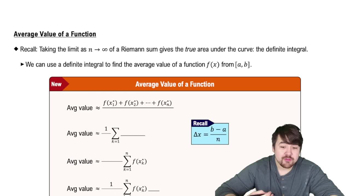
Average Value of a Function

Differentiability and Continuity

A function is differentiable at a point if it is smooth and has no sharp corners or cusps at that point, which also implies it must be continuous there. For f(x) = |x³ − 9x|, checking differentiability at x = 3 involves ensuring the function is continuous and that the left-hand and right-hand derivatives at x = 3 are equal.
Video consigliato:
05:34
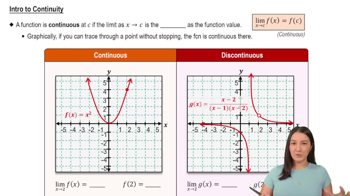
Intro to Continuity
Pratica correlata
Domanda del libro di testo

Checking Antiderivative Formulas


Right, or wrong? Say which for each formula and give a brief reason for each answer.


∫xsinx dx = -x cos x + C

35
views

Domanda del libro di testo

[Technology Exercise] 16. Designing a box with a lid A piece of cardboard measures 10 in. by 15 in. Two equal squares are removed from the corners of a 10-in. side as shown in the figure. Two equal rectangles are removed from the other corners so that the tabs can be folded to form a rectangular box with lid.

" style="" width="335">

b. Find the domain of V for the problem situation and graph V over this domain.

222
views
Domanda del libro di testo

114. Parabolas

b. When is the parabola concave up? Concave down?

383
views
Domanda del libro di testo

Identifying Extrema


In Exercises 63 and 64, the graph of f' is given. Assume that f has domain (-2, 2).


" style="max-width: 100%; white-space-collapse: preserve;" width="190">


b. Either use the graph to determine which intervals f is positive on and which intervals f is negative on, or explain why this information cannot be determined from the graph.

231
views
Domanda del libro di testo

Theory and Examples


Sketch the graph of a differentiable function y = f(x) that has a local maximum at (1, 1) and a local minimum at (3, 3).

217
views
Domanda del libro di testo

Analyzing Functions from Derivatives


Answer the following questions about the functions whose derivatives are given in Exercises 1–14:


b. On what open intervals is f increasing or decreasing?


f′(x) = (x − 1)(x + 2)(x − 3)

209
views