Ch. 7 - Transcendental Functions
Hass - Thomas' Calculus 15th Edition
Hass15th EditionThomas' CalculusISBN: 9780137616077Non è quello che usi tu?Cambia libro di testo
Capitolo 7, Problema 7.PE.109b

109. Does f grow faster, slower, or at the same rate as g as x→∞? Give reasons for your answers.
b. f(x)=x, g(x)=x + 1/x

Guida verificata passo dopo passo
1
Identify the given functions: \(f(x) = x\) and \(g(x) = x + \frac{1}{x}\).
As \(x \to \infty\), analyze the behavior of each function. For \(f(x) = x\), the function grows without bound linearly.
For \(g(x) = x + \frac{1}{x}\), note that \(\frac{1}{x} \to 0\) as \(x \to \infty\), so \(g(x)\) behaves like \(x\) plus a very small positive term.
Compare the growth rates by considering the ratio \(\frac{f(x)}{g(x)} = \frac{x}{x + \frac{1}{x}}\). Simplify this expression to understand the limit as \(x \to \infty\).
Evaluate the limit \(\lim_{x \to \infty} \frac{f(x)}{g(x)}\) to determine if it approaches 0, a finite nonzero constant, or infinity, which tells us if \(f\) grows slower, at the same rate, or faster than \(g\) respectively.

Risposta video verificata per un problema simile:

Questa soluzione video è stata consigliata dai nostri tutor come utile per risolvere questo problema.
Durata del video:
2m

Concetti chiave

Ecco i concetti essenziali che devi comprendere per rispondere correttamente alla domanda.

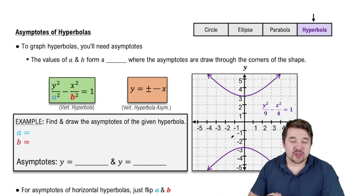
Asymptotic Behavior of Functions

Asymptotic behavior describes how functions behave as the input grows very large (x→∞). It helps compare growth rates by focusing on dominant terms and ignoring smaller ones that become insignificant at infinity.
Video consigliato:
Percorso guidato
5:50
Asymptotes of Hyperbolas

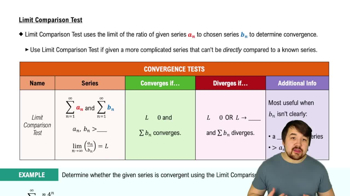
Limits and Limit Comparison

Limits evaluate the value a function approaches as x approaches infinity. Comparing the limit of the ratio f(x)/g(x) as x→∞ determines if one function grows faster, slower, or at the same rate as the other.
Video consigliato:
Percorso guidato
07:45
Limit Comparison Test

Dominant Terms in Functions

The dominant term in a function is the part that grows fastest as x→∞. For example, in g(x) = x + 1/x, the term x dominates because 1/x approaches zero, so the growth rate is mainly determined by x.
Video consigliato:
Percorso guidato
05:44
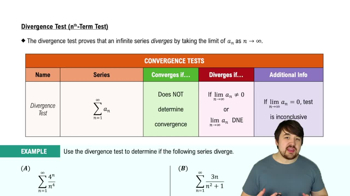
Divergence Test (nth Term Test)