Ch. 7 - Transcendental Functions
Hass - Thomas' Calculus 15th Edition
Hass15th EditionThomas' CalculusISBN: 9780137616077Non è quello che usi tu?Cambia libro di testo
Capitolo 7, Problema 7.PE.113

113. The function f(x) = e^x + x, being differentiable and one-to-one, has a differentiable inverse f^(-1)(x). Find the value of df^(-1)/dx at the point f (ln 2).

Guida verificata passo dopo passo
1
Identify the given function: \(f(x) = e^{x} + x\). We are asked to find the derivative of the inverse function \(f^{-1}(x)\) at the point \(x = f(\ln 2)\).
Recall the formula for the derivative of the inverse function: if \(y = f(x)\) and \(f\) is invertible and differentiable, then \(\frac{d}{dx} f^{-1}(x) = \frac{1}{f'(f^{-1}(x))}\).
Calculate \(f(\ln 2)\) by substituting \(x = \ln 2\) into the original function: \(f(\ln 2) = e^{\ln 2} + \ln 2\).
Find the derivative of the original function: \(f'(x) = \frac{d}{dx}(e^{x} + x) = e^{x} + 1\).
Evaluate \(f'(x)\) at \(x = \ln 2\) to get \(f'(\ln 2) = e^{\ln 2} + 1\). Then, use the inverse derivative formula to write \(\frac{d}{dx} f^{-1}(f(\ln 2)) = \frac{1}{f'(\ln 2)}\).

Risposta video verificata per un problema simile:

Questa soluzione video è stata consigliata dai nostri tutor come utile per risolvere questo problema.
Durata del video:
3m

Concetti chiave

Ecco i concetti essenziali che devi comprendere per rispondere correttamente alla domanda.

Inverse Function and Its Differentiability

If a function is one-to-one and differentiable with a nonzero derivative, its inverse exists and is differentiable. The inverse function reverses the roles of inputs and outputs, allowing us to express x in terms of y = f(x). Understanding this ensures we can apply differentiation rules to the inverse.
Video consigliato:
06:35
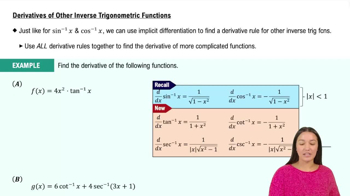
Derivatives of Other Inverse Trigonometric Functions

Derivative of the Inverse Function

The derivative of the inverse function at a point y = f(x) is given by (df^(-1)/dx)(y) = 1 / (df/dx)(x). This formula relates the slope of the inverse function to the slope of the original function, enabling us to find the inverse derivative by evaluating the original function's derivative at the corresponding x.
Video consigliato:
06:35
Derivatives of Other Inverse Trigonometric Functions

Evaluating the Function and Its Derivative at a Specific Point

To find the derivative of the inverse at f(ln 2), we first compute f(ln 2) and then find f'(ln 2). This step is crucial because the inverse derivative depends on the original function's derivative at the point where the inverse is evaluated, linking the values precisely.
Video consigliato:
Percorso guidato
4:26
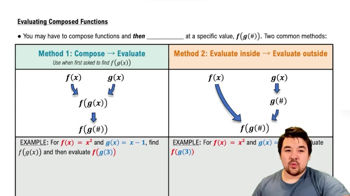
Evaluating Composed Functions