Ch. 7 - Transcendental Functions
Hass - Thomas' Calculus 15th Edition
Hass15th EditionThomas' CalculusISBN: 9780137616077Non è quello che usi tu?Cambia libro di testo
Capitolo 7, Problema 7.3.133

133. Find the absolute maximum value of
f(x) = x^2 * ln(1/x)
and say where it is assumed.

Guida verificata passo dopo passo
1
Rewrite the function to a more convenient form: \(f(x) = x^2 \ln\left(\frac{1}{x}\right) = x^2 (-\ln x) = -x^2 \ln x\) for \(x > 0\) since \(\ln\left(\frac{1}{x}\right)\) is defined only for positive \(x\).
Find the first derivative \(f'(x)\) using the product rule. Let \(u = -x^2\) and \(v = \ln x\), then \(f(x) = u v\). Compute \(f'(x) = u' v + u v'\) where \(u' = -2x\) and \(v' = \frac{1}{x}\).
Set the derivative equal to zero to find critical points: \(f'(x) = 0\). Solve the resulting equation for \(x\) to find candidates for local maxima or minima.
Evaluate the function \(f(x)\) at the critical points found and also consider the behavior of \(f(x)\) as \(x\) approaches the boundaries of the domain (i.e., as \(x \to 0^+\) and as \(x \to \infty\)) to determine the absolute maximum.
Compare the values of \(f(x)\) at the critical points and the limits to identify the absolute maximum value and the point where it is assumed.

Risposta video verificata per un problema simile:

Questa soluzione video è stata consigliata dai nostri tutor come utile per risolvere questo problema.
Durata del video:
9m

Concetti chiave

Ecco i concetti essenziali che devi comprendere per rispondere correttamente alla domanda.

Domain and Behavior of the Function

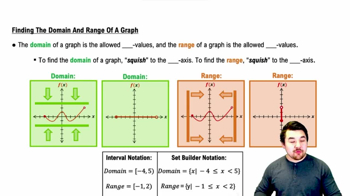
Understanding the domain of f(x) = x^2 * ln(1/x) is crucial since ln(1/x) is defined only for x > 0. Analyzing the behavior near the boundaries (as x approaches 0 and infinity) helps identify potential maximum values and ensures the function is well-defined where we search for extrema.
Video consigliato:
Percorso guidato
5:10
Finding the Domain and Range of a Graph

Finding Critical Points Using Derivatives

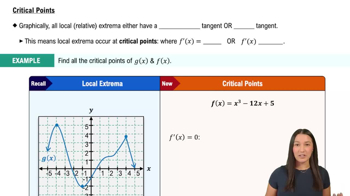
To find absolute maxima, compute the derivative f'(x) and solve f'(x) = 0 to locate critical points. These points are candidates for local maxima or minima. Differentiation involves applying the product and chain rules to handle the x^2 and ln(1/x) terms.
Video consigliato:
04:50
Critical Points

Evaluating Absolute Maximum Values

After finding critical points, evaluate f(x) at these points and at the domain boundaries to determine the absolute maximum. Comparing these values identifies where the function attains its highest value, ensuring a complete analysis of maxima.
Video consigliato:
5:10
Evaluate Composite Functions - Values on Unit Circle