Ch. 7 - Transcendental Functions
Hass - Thomas' Calculus 15th Edition
Hass15th EditionThomas' CalculusISBN: 9780137616077Non è quello che usi tu?Cambia libro di testo
Capitolo 7, Problema 7.3.69

In Exercises 59–86, find the derivative of y with respect to the given independent variable.
69. y = 2^(sin 3t)

Guida verificata passo dopo passo
1
Identify the function to differentiate: \(y = 2^{\sin(3t)}\). This is an exponential function where the base is a constant (2) and the exponent is a function of \(t\).
Recall the general rule for differentiating functions of the form \(a^{u(t)}\), where \(a\) is a constant and \(u(t)\) is a function of \(t\): the derivative is \(\frac{dy}{dt} = a^{u(t)} \cdot \ln(a) \cdot \frac{du}{dt}\).
Set \(u(t) = \sin(3t)\) and find its derivative \(\frac{du}{dt}\). Use the chain rule: the derivative of \(\sin(3t)\) is \(\cos(3t)\) multiplied by the derivative of \$3t$, which is 3. So, \(\frac{du}{dt} = 3 \cos(3t)\).
Apply the formula: \(\frac{dy}{dt} = 2^{\sin(3t)} \cdot \ln(2) \cdot 3 \cos(3t)\).
Write the final expression for the derivative as \(\frac{dy}{dt} = 3 \ln(2) \cdot 2^{\sin(3t)} \cdot \cos(3t)\), which expresses the rate of change of \(y\) with respect to \(t\).

Risposta video verificata per un problema simile:

Questa soluzione video è stata consigliata dai nostri tutor come utile per risolvere questo problema.
Durata del video:
3m

Concetti chiave

Ecco i concetti essenziali che devi comprendere per rispondere correttamente alla domanda.

Chain Rule

The chain rule is used to differentiate composite functions. It states that the derivative of a function composed of another function is the derivative of the outer function evaluated at the inner function times the derivative of the inner function. For example, if y = f(g(t)), then dy/dt = f'(g(t)) * g'(t).
Video consigliato:
05:02
Intro to the Chain Rule

Derivative of Exponential Functions with Variable Exponents

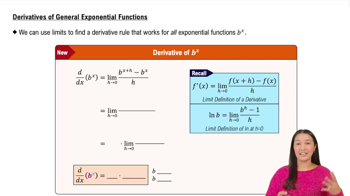
When differentiating functions like a^(u(t)), where the base a is constant and the exponent u(t) is a function of t, rewrite the function using exponentials and logarithms: a^(u) = e^(u ln a). Then apply the chain rule to differentiate e^(u ln a).
Video consigliato:
04:50
Derivatives of General Exponential Functions

Derivative of Trigonometric Functions

The derivative of sine and cosine functions are fundamental in calculus. Specifically, d/dt[sin(kt)] = k cos(kt), where k is a constant. This rule is essential when differentiating expressions like sin(3t) inside the exponent.
Video consigliato:
06:35
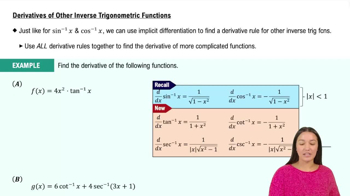
Derivatives of Other Inverse Trigonometric Functions