Ch. 7 - Transcendental Functions
Hass - Thomas' Calculus 15th Edition
Hass15th EditionThomas' CalculusISBN: 9780137616077Non è quello che usi tu?Cambia libro di testo
Capitolo 7, Problema 7.4.15

Solve the differential equation in Exercises 9–22.
15. √x (dy/dx) = e^(y+√x), x > 0

Guida verificata passo dopo passo
1
Rewrite the given differential equation to isolate \( \frac{dy}{dx} \): \[ \sqrt{x} \frac{dy}{dx} = e^{y + \sqrt{x}} \implies \frac{dy}{dx} = \frac{e^{y + \sqrt{x}}}{\sqrt{x}} \].
Express the right-hand side as a product of exponentials to separate variables more easily: \[ \frac{dy}{dx} = \frac{e^y \cdot e^{\sqrt{x}}}{\sqrt{x}}. \]
Rewrite the equation in differential form to separate variables \( y \) and \( x \): \[ \frac{dy}{e^y} = \frac{e^{\sqrt{x}}}{\sqrt{x}} dx. \]
Integrate both sides: \[ \int \frac{1}{e^y} dy = \int \frac{e^{\sqrt{x}}}{\sqrt{x}} dx. \] The left integral simplifies to \( \int e^{-y} dy \).
For the right integral, use substitution: let \( t = \sqrt{x} \), so \( x = t^2 \) and \( dx = 2t dt \). Substitute and simplify the integral accordingly before integrating.

Risposta video verificata per un problema simile:

Questa soluzione video è stata consigliata dai nostri tutor come utile per risolvere questo problema.
Durata del video:
6m

Concetti chiave

Ecco i concetti essenziali che devi comprendere per rispondere correttamente alla domanda.

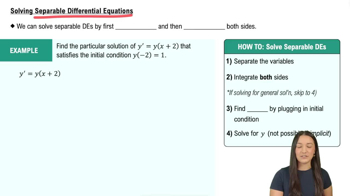
Separable Differential Equations

A separable differential equation can be written so that all terms involving y are on one side and all terms involving x are on the other. This allows integration of each side independently. Recognizing separability is key to solving equations like √x (dy/dx) = e^(y+√x).
Video consigliato:
06:06
Solving Separable Differential Equations

Integration Techniques

Solving separable equations requires integrating functions of x and y separately. Familiarity with integrating exponential functions and substitutions, such as u = √x, helps simplify the integrals and find the general solution.
Video consigliato:
Percorso guidato
06:18
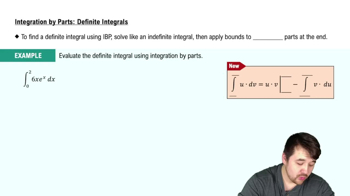
Integration by Parts for Definite Integrals

Implicit and Explicit Solutions

After integration, solutions may be implicit or explicit. Understanding how to manipulate and interpret these forms is important, especially when the solution involves expressions like e^(y+√x), which may require logarithmic manipulation to isolate y.
Video consigliato:
Percorso guidato
05:14
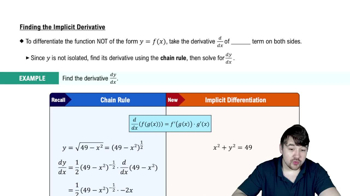
Finding The Implicit Derivative