Ch. 7 - Transcendental Functions
Hass - Thomas' Calculus 15th Edition
Hass15th EditionThomas' CalculusISBN: 9780137616077Non è quello che usi tu?Cambia libro di testo
Capitolo 7, Problema 7.4.37

37. Plutonium-239 The half-life of the plutonium isotope is 24,360 years. If 10 g of plutonium is released into the atmosphere by a nuclear accident, how many years will it take for 80% of the isotope to decay?

Guida verificata passo dopo passo
1
Identify the decay model: The amount of plutonium remaining after time \(t\) can be modeled by the exponential decay formula \(A(t) = A_0 \cdot e^{-kt}\), where \(A_0\) is the initial amount, \(k\) is the decay constant, and \(t\) is time in years.
Use the half-life to find the decay constant \(k\): Since the half-life \(T_{1/2}\) is 24,360 years, use the relation \(k = \frac{\ln(2)}{T_{1/2}} = \frac{\ln(2)}{24360}\) to calculate \(k\).
Set up the equation for 80% decay: If 80% of the plutonium decays, 20% remains. So, \(A(t) = 0.2 \times A_0\). Substitute into the decay formula to get \(0.2 A_0 = A_0 \cdot e^{-kt}\).
Simplify the equation: Cancel \(A_0\) from both sides to get \(0.2 = e^{-kt}\). Then take the natural logarithm of both sides to solve for \(t\): \(\ln(0.2) = -kt\).
Solve for \(t\): Rearrange to find \(t = -\frac{\ln(0.2)}{k}\). Substitute the value of \(k\) from step 2 to express \(t\) in terms of known quantities.

Risposta video verificata per un problema simile:

Questa soluzione video è stata consigliata dai nostri tutor come utile per risolvere questo problema.
Durata del video:
2m

Concetti chiave

Ecco i concetti essenziali che devi comprendere per rispondere correttamente alla domanda.

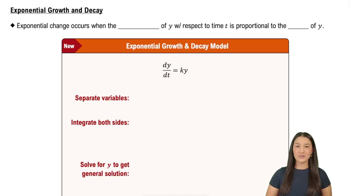
Exponential Decay

Exponential decay describes the process where a quantity decreases at a rate proportional to its current value. In radioactive decay, the amount of substance decreases exponentially over time, modeled by the formula N(t) = N_0 * e^(-kt), where k is the decay constant.
Video consigliato:
09:29
Exponential Growth & Decay

Half-Life

Half-life is the time required for half of a radioactive substance to decay. It is a constant unique to each isotope and relates to the decay constant by the formula t_(1/2) = ln(2)/k. Knowing the half-life allows calculation of the decay constant and prediction of remaining substance over time.
Video consigliato:
6:32
Finding Global Extrema (Extreme Value Theorem) Example 3

Decay Constant and Time Calculation

The decay constant (k) quantifies the rate of decay and is used to find the time for a certain fraction of the substance to decay. By rearranging the decay formula, time can be calculated as t = -(1/k) * ln(N(t)/N_0), enabling determination of how long it takes for a specific percentage of the isotope to decay.
Video consigliato:
09:29
Exponential Growth & Decay