Ch. 7 - Transcendental Functions
Hass - Thomas' Calculus 15th Edition
Hass15th EditionThomas' CalculusISBN: 9780137616077Non è quello che usi tu?Cambia libro di testo
Capitolo 7, Problema 7.5.82

82. For what values of a and b is
lim(x→0)(tan(2x/x³) + a/x² + sin(bx)/x) = 0?

Guida verificata passo dopo passo
1
Rewrite the limit expression clearly: \(\lim_{x \to 0} \left( \tan\left( \frac{2x}{x^3} \right) + \frac{a}{x^2} + \frac{\sin(bx)}{x} \right) = 0\).
Simplify the argument inside the tangent function: \(\frac{2x}{x^3} = \frac{2}{x^2}\). So the expression becomes \(\tan\left( \frac{2}{x^2} \right) + \frac{a}{x^2} + \frac{\sin(bx)}{x}\).
Analyze the behavior of each term as \(x \to 0\). Notice that \(\tan\left( \frac{2}{x^2} \right)\) oscillates wildly and does not have a limit, so for the overall limit to exist and be zero, the terms involving \(a\) and \(b\) must cancel or control the behavior.
Consider using series expansions or asymptotic behavior for \(\sin(bx)\) near zero: \(\sin(bx) \approx bx\) for small \(x\), so \(\frac{\sin(bx)}{x} \approx b\). This term tends to \(b\) as \(x \to 0\).
Since \(\tan\left( \frac{2}{x^2} \right)\) does not have a limit, the only way for the entire limit to be zero is if the expression inside the limit is defined differently or if the problem is reconsidered. Re-examine the problem statement or check for possible typos in the expression.

Risposta video verificata per un problema simile:

Questa soluzione video è stata consigliata dai nostri tutor come utile per risolvere questo problema.
Durata del video:
3m

Concetti chiave

Ecco i concetti essenziali che devi comprendere per rispondere correttamente alla domanda.

Limit of a Function as x Approaches a Point

The limit describes the value a function approaches as the input approaches a specific point. Understanding how to evaluate limits, especially when direct substitution leads to indeterminate forms, is essential for analyzing behavior near that point.
Video consigliato:
06:11
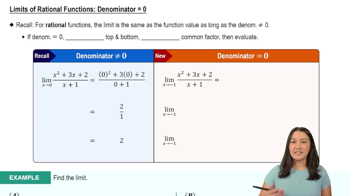
Limits of Rational Functions: Denominator = 0

Series Expansion (Taylor or Maclaurin Series)

Series expansions approximate functions near a point using polynomials. For small x, functions like tan(2x), sin(bx), and powers of x can be expanded to simplify complex expressions and identify dominant terms affecting the limit.
Video consigliato:
08:26
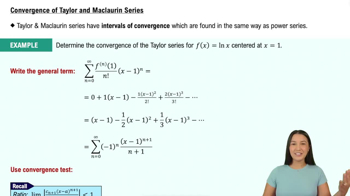
Convergence of Taylor & Maclaurin Series

Handling Indeterminate Forms and Coefficient Matching

When limits yield expressions like 0/0 or ∞ - ∞, rewriting terms via expansions helps resolve indeterminacies. Matching coefficients of powers of x ensures the limit exists and equals the desired value, allowing determination of unknown parameters a and b.
Video consigliato:
6:04
Introduction to Polynomial Functions