Ch. 7 - Transcendental Functions
Hass - Thomas' Calculus 15th Edition
Hass15th EditionThomas' CalculusISBN: 9780137616077Non è quello che usi tu?Cambia libro di testo
Capitolo 7, Problema 7.3.65

In Exercises 59–86, find the derivative of y with respect to the given independent variable.
65. y = (cos θ)^(√2)

Guida verificata passo dopo passo
1
Identify the function given: \(y = (\cos \theta)^{\sqrt{2}}\). Here, \(y\) is a function of \(\theta\).
Recognize that the function is of the form \(y = [u(\theta)]^n\) where \(u(\theta) = \cos \theta\) and \(n = \sqrt{2}\), a constant exponent.
Apply the general power rule combined with the chain rule for differentiation: \(\frac{dy}{d\theta} = n [u(\theta)]^{n-1} \cdot \frac{du}{d\theta}\).
Calculate the derivative of the inner function: \(\frac{d}{d\theta}(\cos \theta) = -\sin \theta\).
Substitute back into the formula to express the derivative: \(\frac{dy}{d\theta} = \sqrt{2} (\cos \theta)^{\sqrt{2} - 1} (-\sin \theta)\).

Risposta video verificata per un problema simile:

Questa soluzione video è stata consigliata dai nostri tutor come utile per risolvere questo problema.
Durata del video:
2m

Concetti chiave

Ecco i concetti essenziali che devi comprendere per rispondere correttamente alla domanda.

Chain Rule

The chain rule is used to differentiate composite functions, where one function is inside another. It states that the derivative of f(g(x)) is f'(g(x)) multiplied by g'(x). In this problem, since y = (cos θ)^(√2) is a composition of the cosine function raised to a power, the chain rule helps differentiate the outer power function and the inner cosine function.
Video consigliato:
05:02
Intro to the Chain Rule

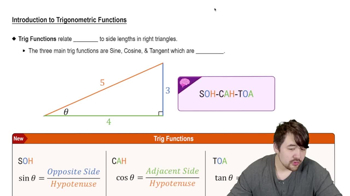
Differentiation of Trigonometric Functions

Understanding how to differentiate trigonometric functions like cosine is essential. The derivative of cos θ with respect to θ is -sin θ. This derivative is a key part of applying the chain rule when differentiating expressions involving trigonometric functions.
Video consigliato:
Percorso guidato
6:04
Introduction to Trigonometric Functions

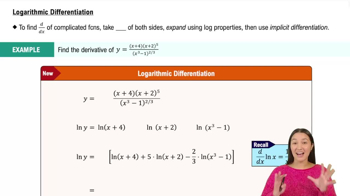
Logarithmic Differentiation

Logarithmic differentiation is useful when differentiating functions with variable exponents, such as (cos θ)^(√2). By taking the natural logarithm of both sides, the exponent can be brought down, simplifying the differentiation process. This technique helps handle powers that are constants or functions.
Video consigliato:
06:30
Logarithmic Differentiation