Ch. 7 - Transcendental Functions
Hass - Thomas' Calculus 15th Edition
Hass15th EditionThomas' CalculusISBN: 9780137616077Non è quello che usi tu?Cambia libro di testo
Capitolo 7, Problema 7.7.71b

Evaluate the integrals in Exercises 67–74 in terms of
b. natural logarithms.
71. ∫(from 1/5 to 3/13)dx/(x√(1-16x²))

Guida verificata passo dopo passo
1
Recognize that the integral has the form \( \int \frac{dx}{x \sqrt{1 - a^2 x^2}} \) where \( a = 4 \) because \( 16x^2 = (4x)^2 \). This suggests a substitution related to inverse hyperbolic or trigonometric functions, but since the problem asks for an expression in terms of natural logarithms, we will use an appropriate substitution to rewrite the integral accordingly.
Use the substitution \( t = \sqrt{1 - 16x^2} \). Then, differentiate both sides to express \( dx \) in terms of \( dt \) and \( x \). This will help rewrite the integral in terms of \( t \) and simplify the square root expression.
Rewrite the integral limits from \( x = \frac{1}{5} \) and \( x = \frac{3}{13} \) to the corresponding values of \( t \) using the substitution \( t = \sqrt{1 - 16x^2} \). This is necessary to evaluate the definite integral after substitution.
After substitution, simplify the integral to a form involving \( \frac{dt}{1 - t^2} \) or a similar rational function that can be integrated into a natural logarithm expression using partial fractions or standard integral formulas.
Integrate the simplified expression to obtain a result in terms of natural logarithms, then substitute back to the original variable \( x \) and apply the limits to express the definite integral fully in terms of natural logarithms.

Risposta video verificata per un problema simile:

Questa soluzione video è stata consigliata dai nostri tutor come utile per risolvere questo problema.
Durata del video:
9m

Concetti chiave

Ecco i concetti essenziali che devi comprendere per rispondere correttamente alla domanda.

Integration involving square roots of quadratic expressions

Integrals containing expressions like √(1 - a²x²) often require trigonometric substitution to simplify the integrand. Recognizing the form allows substitution such as x = (1/a)sin(θ), transforming the integral into a trigonometric integral that is easier to evaluate.
Video consigliato:
03:33
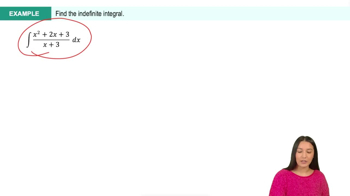
Integrals Involving Natural Logs: Substitution Example 7

Trigonometric substitution

Trigonometric substitution replaces variables in integrals involving √(1 - x²), √(1 + x²), or √(x² - 1) with trigonometric functions to simplify the integral. This method leverages identities like sin²θ + cos²θ = 1 to rewrite the integrand in terms of θ, facilitating integration.
Video consigliato:
Percorso guidato
6:04
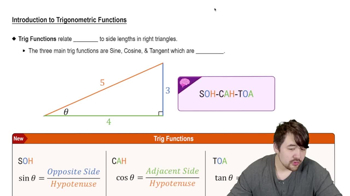
Introduction to Trigonometric Functions

Expressing results in terms of natural logarithms

After performing trigonometric substitution and integration, the final answer often involves inverse trigonometric functions or logarithms. Converting inverse trigonometric expressions into natural logarithms uses known identities, enabling the integral to be expressed in terms of natural logarithms as requested.
Video consigliato:
05:18
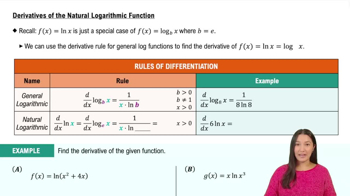
Derivative of the Natural Logarithmic Function