Ch. 7 - Transcendental Functions
Hass - Thomas' Calculus 15th Edition
Hass15th EditionThomas' CalculusISBN: 9780137616077Non è quello che usi tu?Cambia libro di testo
Capitolo 7, Problema 7.6.135b

Find the volumes of the solids in Exercises 135 and 136.
135. The solid lies between planes perpendicular to the x-axis at x=-1 and x=1. The cross-sections perpendicular to the x-axis are
b. vertical squares whose base edges run from the curve y=-1/√(1+x²) to the curve y=1/√(1+x²).

Guida verificata passo dopo passo
1
Identify the interval over which the solid extends along the x-axis, which is from \(x = -1\) to \(x = 1\).
Determine the length of the base of each square cross-section at a given \(x\). The base runs vertically from \(y = -\frac{1}{\sqrt{1+x^2}}\) to \(y = \frac{1}{\sqrt{1+x^2}}\), so the base length is the difference between these two values.
Calculate the base length as \(\text{base} = \frac{1}{\sqrt{1+x^2}} - \left(-\frac{1}{\sqrt{1+x^2}}\right) = \frac{2}{\sqrt{1+x^2}}\).
Since the cross-sections are squares, the area of each cross-section is \(A(x) = \left(\text{base}\right)^2 = \left(\frac{2}{\sqrt{1+x^2}}\right)^2\).
Set up the volume integral by integrating the cross-sectional area along the x-axis: \(V = \int_{-1}^{1} A(x) \, dx = \int_{-1}^{1} \left(\frac{2}{\sqrt{1+x^2}}\right)^2 \, dx\). This integral will give the volume of the solid.

Risposta video verificata per un problema simile:

Questa soluzione video è stata consigliata dai nostri tutor come utile per risolvere questo problema.
Durata del video:
5m

Concetti chiave

Ecco i concetti essenziali che devi comprendere per rispondere correttamente alla domanda.

Volume of a Solid with Known Cross-Sections

This method involves finding the volume of a solid by integrating the area of cross-sectional shapes perpendicular to an axis. For each x-value, the area of the cross-section is computed, then integrated over the given interval to find the total volume.
Video consigliato:
05:38
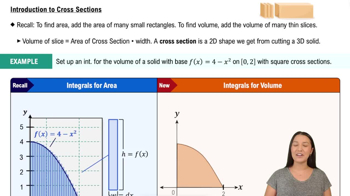
Introduction to Cross Sections

Determining the Side Length of the Square Cross-Section

The side length of each square cross-section is the vertical distance between the two curves y = -1/√(1+x²) and y = 1/√(1+x²). Calculating this length correctly is essential to find the area of the square at each x.
Video consigliato:
05:38
Introduction to Cross Sections

Definite Integration over the Interval

Once the area of the cross-section is expressed as a function of x, definite integration from x = -1 to x = 1 sums these areas to find the volume. Understanding how to set up and evaluate this integral is crucial.
Video consigliato:
Percorso guidato
05:43
Definition of the Definite Integral