Ch. 7 - Transcendental Functions
Hass - Thomas' Calculus 15th Edition
Hass15th EditionThomas' CalculusISBN: 9780137616077Non è quello che usi tu?Cambia libro di testo
Capitolo 7, Problema 7.6.6b

Use reference triangles in an appropriate quadrant to find the angles in Exercises 1–8.
6. b. arccsc(-2/√3)

Guida verificata passo dopo passo
1
Recall that \( \arccsc(x) \) is the inverse cosecant function, which gives an angle \( \theta \) such that \( \csc(\theta) = x \). Here, we want to find \( \theta = \arccsc\left(-\frac{2}{\sqrt{3}}\right) \).
Rewrite the cosecant in terms of sine: since \( \csc(\theta) = \frac{1}{\sin(\theta)} \), we have \( \sin(\theta) = \frac{1}{\csc(\theta)} = \frac{1}{-\frac{2}{\sqrt{3}}} = -\frac{\sqrt{3}}{2} \).
Determine the reference angle by considering the positive value of sine: \( \sin(\theta_{ref}) = \frac{\sqrt{3}}{2} \). From the unit circle, this corresponds to an angle of \( \frac{\pi}{3} \) radians (or 60 degrees).
Since the sine value is negative and cosecant is negative, identify the quadrant where sine is negative. Sine is negative in Quadrants III and IV. The principal range of \( \arccsc(x) \) is \( [-\frac{\pi}{2}, 0) \cup (0, \frac{\pi}{2}] \) excluding zero, so the angle must be in Quadrant IV (negative angle between 0 and \( -\frac{\pi}{2} \)).
Therefore, the angle \( \theta \) is the negative of the reference angle, so \( \theta = -\frac{\pi}{3} \). This is the angle in the appropriate quadrant corresponding to \( \arccsc\left(-\frac{2}{\sqrt{3}}\right) \).

Risposta video verificata per un problema simile:

Questa soluzione video è stata consigliata dai nostri tutor come utile per risolvere questo problema.
Durata del video:
2m

Concetti chiave

Ecco i concetti essenziali che devi comprendere per rispondere correttamente alla domanda.

Inverse Trigonometric Functions

Inverse trigonometric functions, like arccsc, return the angle whose trigonometric ratio equals a given value. For arccsc(x), it gives the angle whose cosecant is x. Understanding their domains and ranges is essential to find correct angle values.
Video consigliato:
06:35
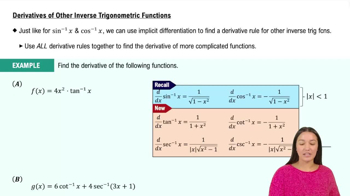
Derivatives of Other Inverse Trigonometric Functions

Reference Triangles

Reference triangles are right triangles used to relate trigonometric ratios to angles in different quadrants. By constructing a triangle with known side ratios, you can determine the reference angle and then adjust for the correct quadrant.
Video consigliato:
Percorso guidato
6:04
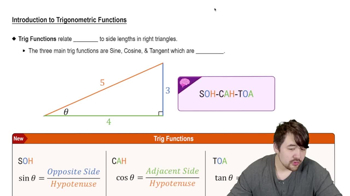
Introduction to Trigonometric Functions

Quadrant Sign Rules

Trigonometric functions have specific signs in each quadrant. Since arccsc(-2/√3) is negative, the angle lies where cosecant is negative (quadrants II or IV). Knowing these sign rules helps identify the correct quadrant for the angle.
Video consigliato:
7:39
Introduction to Exponent Rules