Ch. 1 - Equations and Inequalities
Blitzer - College Algebra 8th Edition
Blitzer8th EditionCollege AlgebraISBN: 9780136970514Non è quello che usi tu?Cambia libro di testo
Capitolo 2, Problema 27

Exercises 27–40 contain linear equations with constants in denominators. Solve each equation. x/3 = x/2 - 2

Guida verificata passo dopo passo
1
Identify the equation: \(\frac{x}{3} = \frac{x}{2} - 2\).
Find the least common denominator (LCD) of the denominators 3 and 2, which is 6.
Multiply every term in the equation by the LCD (6) to eliminate the denominators: \(6 \times \frac{x}{3} = 6 \times \frac{x}{2} - 6 \times 2\).
Simplify each term after multiplication: \(2x = 3x - 12\).
Isolate the variable \(x\) by subtracting \$3x$ from both sides: \(2x - 3x = -12\), then simplify to get $-x = -12$.

Risposta video verificata per un problema simile:

Questa soluzione video è stata consigliata dai nostri tutor come utile per risolvere questo problema.
Durata del video:
3m

Concetti chiave

Ecco i concetti essenziali che devi comprendere per rispondere correttamente alla domanda.

Solving Linear Equations

A linear equation is an algebraic equation in which each term is either a constant or the product of a constant and a single variable. Solving such equations involves isolating the variable on one side to find its value. Techniques include combining like terms and performing inverse operations.
Video consigliato:
04:02
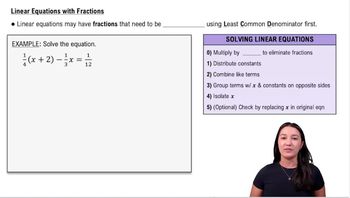
Solving Linear Equations with Fractions

Clearing Fractions by Multiplying Both Sides

When an equation contains fractions, multiplying both sides by the least common denominator (LCD) eliminates the denominators, simplifying the equation. This step helps avoid dealing with fractions and makes solving the equation more straightforward.
Video consigliato:
03:42
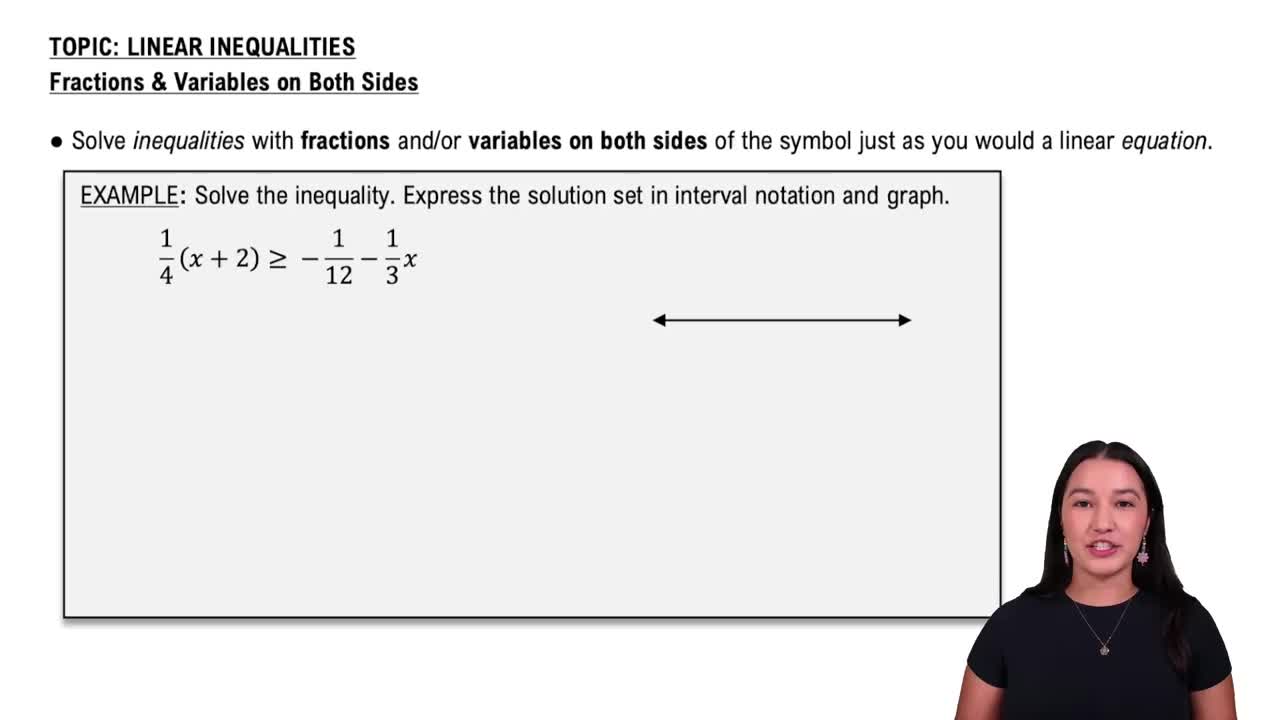
Linear Inequalities with Fractions & Variables on Both Sides

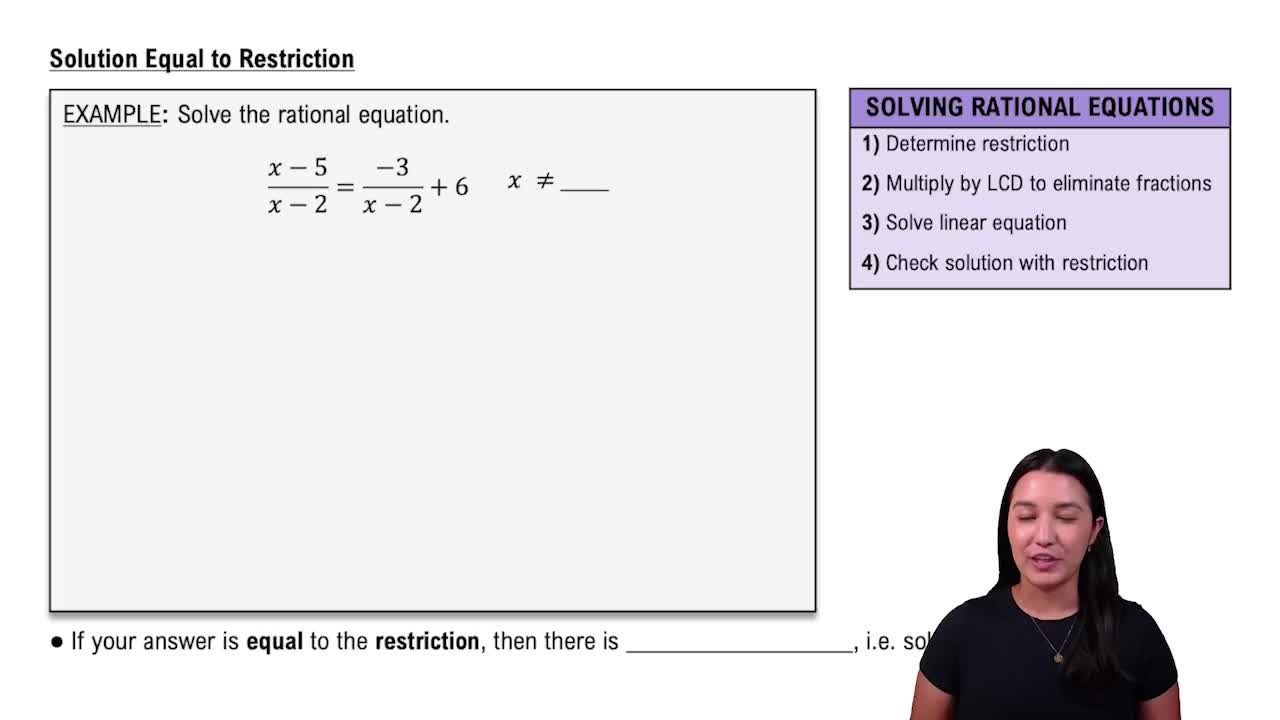
Checking for Extraneous Solutions

After solving an equation, especially those involving variables in denominators, it is important to check solutions by substituting them back into the original equation. This ensures no solution makes a denominator zero, which would be undefined and thus extraneous.
Video consigliato:
05:21
Restrictions on Rational Equations