Exercises 41–60 contain rational equations with variables in denominators. For each equation, a. write the value or values of the variable that make a denominator zero. These are the restrictions on the variable. b. Keeping the restrictions in mind, solve the equation. 4/x = 5/2x + 3
Ch. 1 - Equations and Inequalities

Capitolo 2, Problema 40a
Exercises 27–40 contain linear equations with constants in denominators. Solve each equation. 3x/5 - (x - 3)/2 = (x + 2)/3
Guida verificata passo dopo passo1
Step 1: Identify the least common denominator (LCD) of all the denominators in the equation. The denominators are 5, 2, and 3. The LCD is 30.
Step 2: Multiply every term in the equation by the LCD (30) to eliminate the fractions. This means multiplying each term by 30 and simplifying.
Step 3: Distribute the multiplication across each term. For example, 30 * (3x/5) becomes (30 * 3x) / 5, which simplifies to 18x. Repeat this process for the other terms.
Step 4: After clearing the fractions, simplify the resulting equation by combining like terms and isolating the variable (x). This may involve distributing, combining terms, and moving terms across the equals sign.
Step 5: Solve for x by dividing or performing any necessary operations to isolate x completely. Check your solution by substituting it back into the original equation to ensure it satisfies the equation.

Risposta video verificata per un problema simile:
Questa soluzione video è stata consigliata dai nostri tutor come utile per risolvere questo problema.
Durata del video:
4mConcetti chiave
Ecco i concetti essenziali che devi comprendere per rispondere correttamente alla domanda.
Linear Equations
Linear equations are mathematical statements that express the equality of two linear expressions. They typically take the form ax + b = c, where a, b, and c are constants, and x is the variable. Understanding how to manipulate these equations is essential for solving them, as it involves isolating the variable on one side of the equation.
Video consigliato:
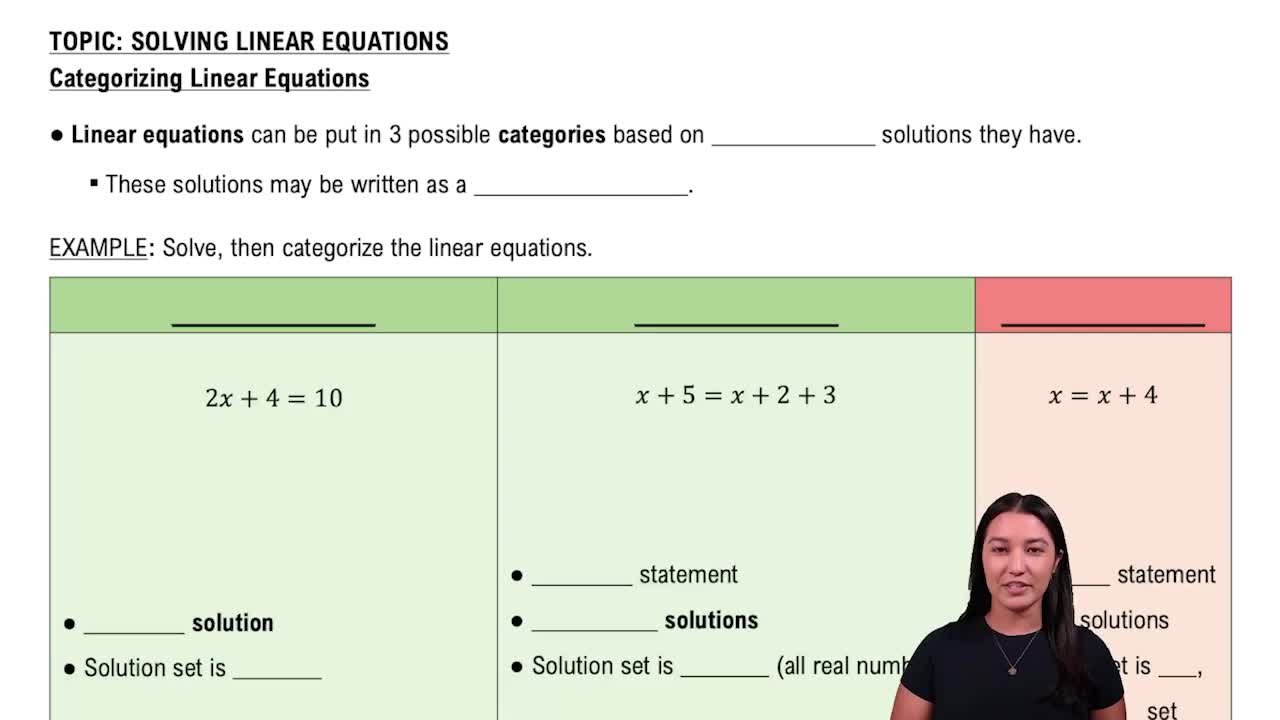
Categorizing Linear Equations
Common Denominator
When dealing with fractions in linear equations, finding a common denominator is crucial for simplifying the equation. The common denominator allows you to eliminate the fractions by multiplying each term by this value, making it easier to solve for the variable. This step is particularly important when the equation contains multiple fractions with different denominators.
Video consigliato:
Rationalizing Denominators
Isolating the Variable
Isolating the variable is a key step in solving linear equations, where the goal is to get the variable (e.g., x) alone on one side of the equation. This often involves performing inverse operations, such as addition, subtraction, multiplication, or division, to both sides of the equation. Mastery of this concept is essential for finding the solution to the equation.
Video consigliato:
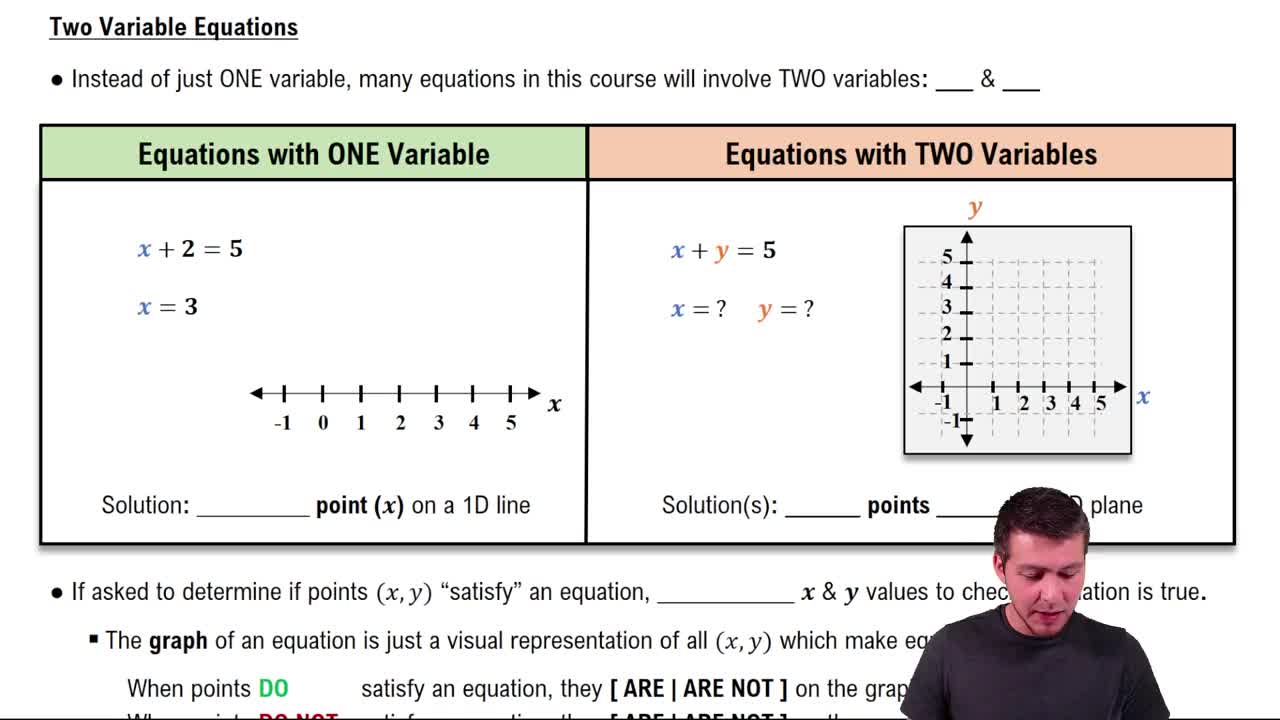
Equations with Two Variables
Pratica correlata
Domanda del libro di testo
972
views
Domanda del libro di testo
In Exercises 35–46, determine the constant that should be added to the binomial so that it becomes a perfect square trinomial. Then write and factor the trinomial. x2 + 3x
1236
views
Domanda del libro di testo
In Exercises 37–52, perform the indicated operations and write the result in standard form. 5√-16 + 3√-81
249
views
Domanda del libro di testo
In all exercises, other than exercises with no solution, use interval notation to express solution sets and graph each solution set on a number line. In Exercises 27–50, solve each linear inequality. x/4 - 3/2 ≤ x/2 + 1
822
views
Domanda del libro di testo
In Exercises 37–52, perform the indicated operations and write the result in standard form. (- 2 + √-4)2
837
views
Domanda del libro di testo
Solve each equation with rational exponents in Exercises 31–40. Check all proposed solutions.
860
views
