Ch. 1 - Equations and Inequalities
Blitzer - College Algebra 8th Edition
Blitzer8th EditionCollege AlgebraISBN: 9780136970514Non è quello che usi tu?Cambia libro di testo
Capitolo 2, Problema 41

Exercises 41–60 contain rational equations with variables in denominators. For each equation, a. write the value or values of the variable that make a denominator zero. These are the restrictions on the variable. b. Keeping the restrictions in mind, solve the equation. 4/x = 5/2x + 3

Guida verificata passo dopo passo
1
Identify the denominators in the equation \(\frac{4}{x} = \frac{5}{2x + 3}\). The denominators are \(x\) and \(2x + 3\).
Find the values of \(x\) that make the denominators zero to determine the restrictions. Solve \(x = 0\) and \(2x + 3 = 0\) separately.
From \(2x + 3 = 0\), solve for \(x\) by isolating \(x\): \(2x = -3\), so \(x = -\frac{3}{2}\). These values (\(x = 0\) and \(x = -\frac{3}{2}\)) are restrictions and cannot be solutions.
Multiply both sides of the original equation by the least common denominator (LCD), which is \(x(2x + 3)\), to eliminate the denominators. This gives: \(4(2x + 3) = 5x\).
Expand and simplify the resulting equation, then solve for \(x\). After finding the solutions, check each against the restrictions to ensure they are valid.

Risposta video verificata per un problema simile:

Questa soluzione video è stata consigliata dai nostri tutor come utile per risolvere questo problema.
Durata del video:
3m

Concetti chiave

Ecco i concetti essenziali che devi comprendere per rispondere correttamente alla domanda.

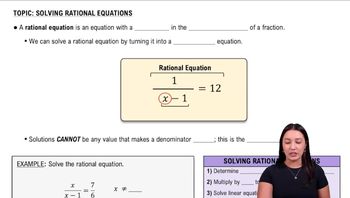
Rational Equations

Rational equations are equations that involve fractions with polynomials in the numerator and denominator. Solving them often requires finding a common denominator or multiplying both sides by the least common denominator to eliminate fractions and simplify the equation.
Video consigliato:
05:56
Introduction to Rational Equations

Restrictions on the Variable

Restrictions are values of the variable that make any denominator zero, which are undefined in mathematics. Identifying these values is crucial before solving the equation to avoid invalid solutions and ensure the solution set is correct.
Video consigliato:
05:28
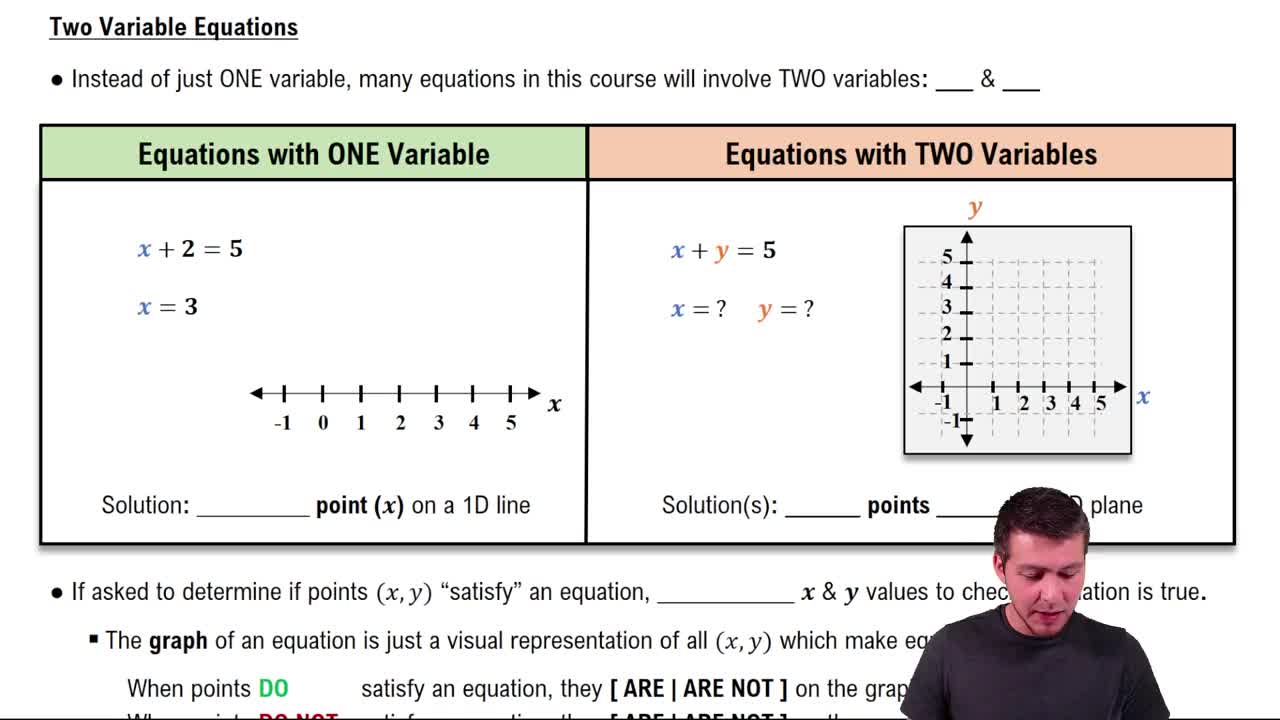
Equations with Two Variables

Solving Linear Equations After Clearing Denominators

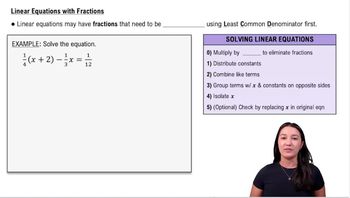
Once denominators are cleared by multiplying both sides by the least common denominator, the equation becomes a linear equation. Solving this involves isolating the variable using inverse operations like addition, subtraction, multiplication, or division.
Video consigliato:
04:02
Solving Linear Equations with Fractions