Ch. 1 - Equations and Inequalities
Blitzer - College Algebra 8th Edition
Blitzer8th EditionCollege AlgebraISBN: 9780136970514Non è quello che usi tu?Cambia libro di testo
Capitolo 2, Problema 22

Solve each equation. Then state whether the equation is an identity, a conditional equation, or an inconsistent equation. 7x + 13 = 2(2x-5) + 3x + 23

Guida verificata passo dopo passo
1
Start by expanding the right-hand side of the equation \(7x + 13 = 2(2x - 5) + 3x + 23\). Use the distributive property to multiply \(2\) by each term inside the parentheses: \(2 \times 2x\) and \(2 \times (-5)\).
Rewrite the equation after distribution: \(7x + 13 = 4x - 10 + 3x + 23\). Next, combine like terms on the right-hand side: combine \$4x$ and \$3x$, and combine $-10$ and \(23\).
After combining like terms, the equation becomes \(7x + 13 = 7x + 13\). Now, subtract \$7x$ from both sides to isolate the constants and variables separately.
Simplify the resulting equation after subtraction. You should get an equation involving only constants. Analyze this simplified equation to determine if it is always true, sometimes true, or never true.
Based on the simplified equation, classify the original equation as an identity (true for all values of \(x\)), a conditional equation (true for specific values of \(x\)), or an inconsistent equation (no solution).

Risposta video verificata per un problema simile:

Questa soluzione video è stata consigliata dai nostri tutor come utile per risolvere questo problema.
Durata del video:
2m

Concetti chiave

Ecco i concetti essenziali che devi comprendere per rispondere correttamente alla domanda.

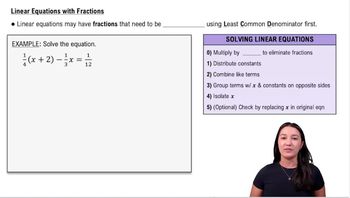
Solving Linear Equations

Solving linear equations involves isolating the variable on one side of the equation using inverse operations such as addition, subtraction, multiplication, and division. The goal is to find the value of the variable that makes the equation true.
Video consigliato:
04:02
Solving Linear Equations with Fractions

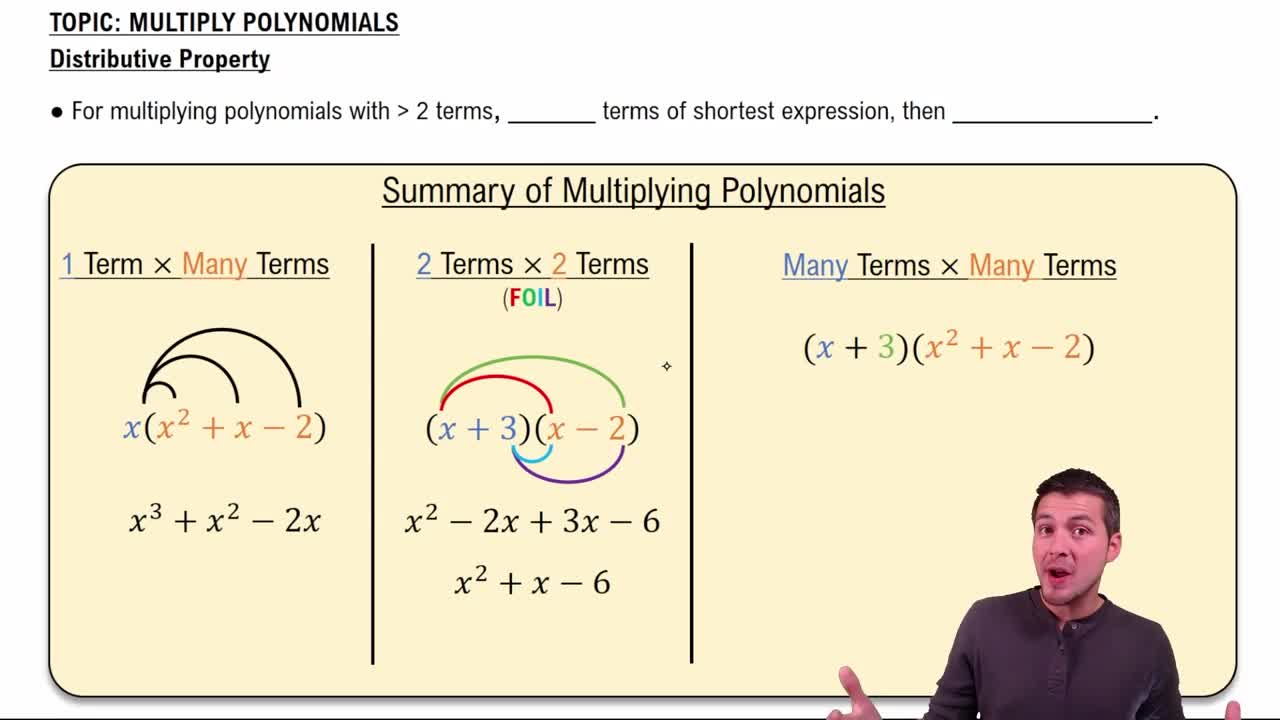
Distributive Property

The distributive property allows you to multiply a single term by each term inside parentheses, transforming expressions like a(b + c) into ab + ac. This step is essential for simplifying and solving equations involving parentheses.
Video consigliato:
04:15
Multiply Polynomials Using the Distributive Property

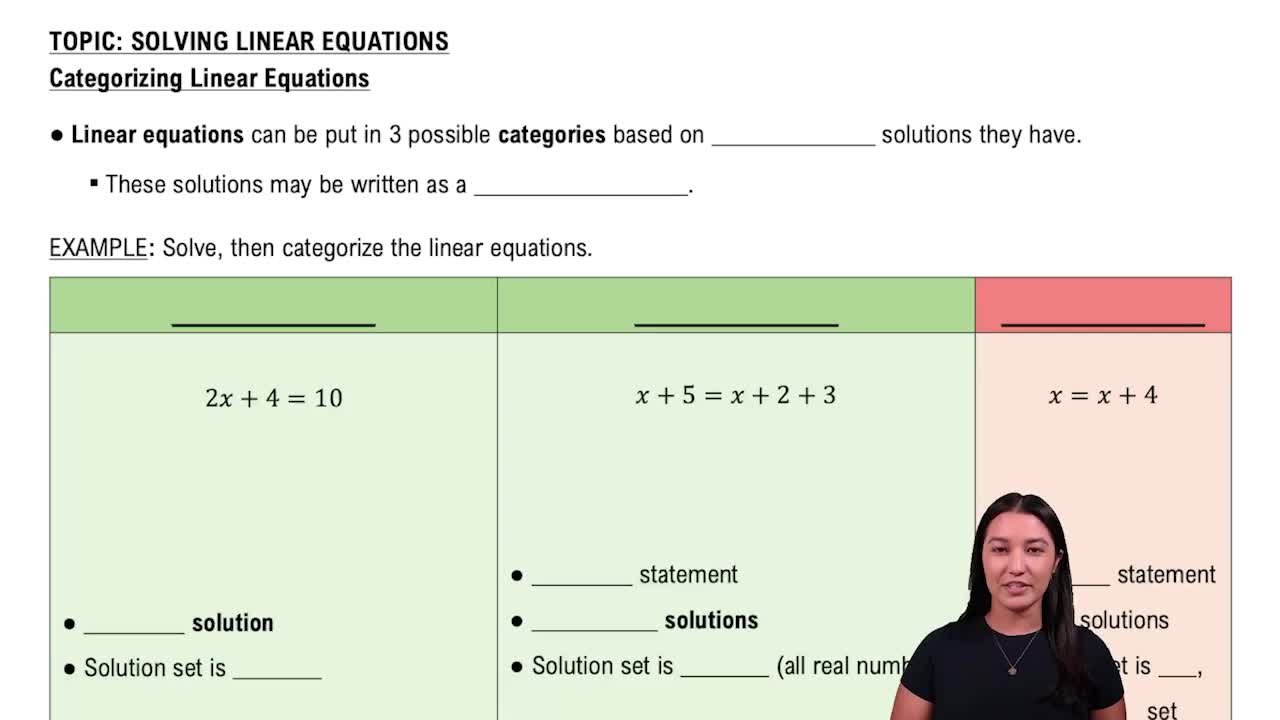
Types of Equations: Identity, Conditional, and Inconsistent

An identity is true for all variable values, a conditional equation is true for specific values, and an inconsistent equation has no solution. Identifying the type depends on the solution set after solving the equation.
Video consigliato:
06:00
Categorizing Linear Equations