Ch. 1 - Equations and Inequalities
Blitzer - College Algebra 8th Edition
Blitzer8th EditionCollege AlgebraISBN: 9780136970514Non è quello che usi tu?Cambia libro di testo
Capitolo 2, Problema 23

Solve each equation in Exercises 15–34 by the square root property. 3(x−4)2=153(x - 4)^2 = 15

Guida verificata passo dopo passo
1
Start with the given equation: \(3(x - 4)^2 = 15\).
Divide both sides of the equation by 3 to isolate the squared term: \((x - 4)^2 = \frac{15}{3}\).
Simplify the right side: \((x - 4)^2 = 5\).
Apply the square root property, which states that if \(a^2 = b\), then \(a = \pm \sqrt{b}\). So, \(x - 4 = \pm \sqrt{5}\).
Solve for \(x\) by adding 4 to both sides: \(x = 4 \pm \sqrt{5}\).

Risposta video verificata per un problema simile:

Questa soluzione video è stata consigliata dai nostri tutor come utile per risolvere questo problema.
Durata del video:
2m

Concetti chiave

Ecco i concetti essenziali che devi comprendere per rispondere correttamente alla domanda.

Square Root Property

The square root property states that if x² = k, then x = ±√k. This property is used to solve equations where a variable is squared and isolated, allowing you to take the square root of both sides to find the variable's values.
Video consigliato:
02:20
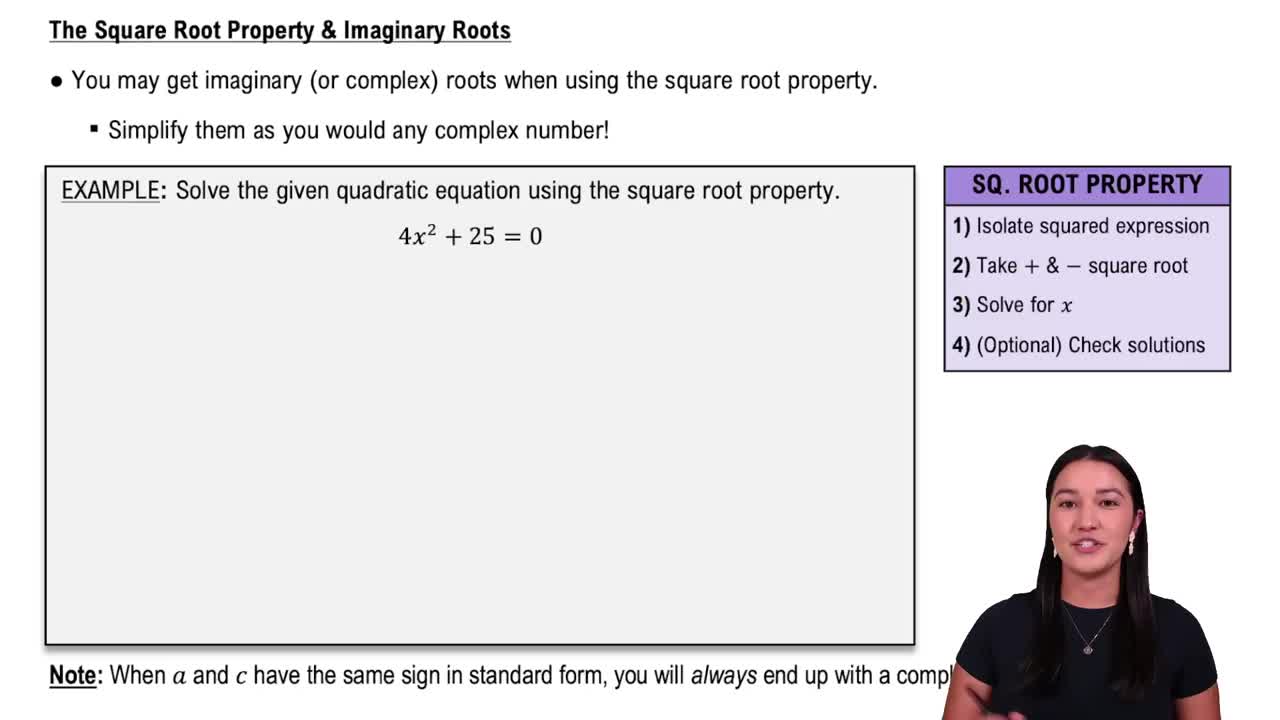
Imaginary Roots with the Square Root Property

Isolating the Squared Term

Before applying the square root property, the equation must be manipulated so that the squared term stands alone on one side. This often involves dividing or simplifying the equation to isolate the expression with the exponent.
Video consigliato:
06:24
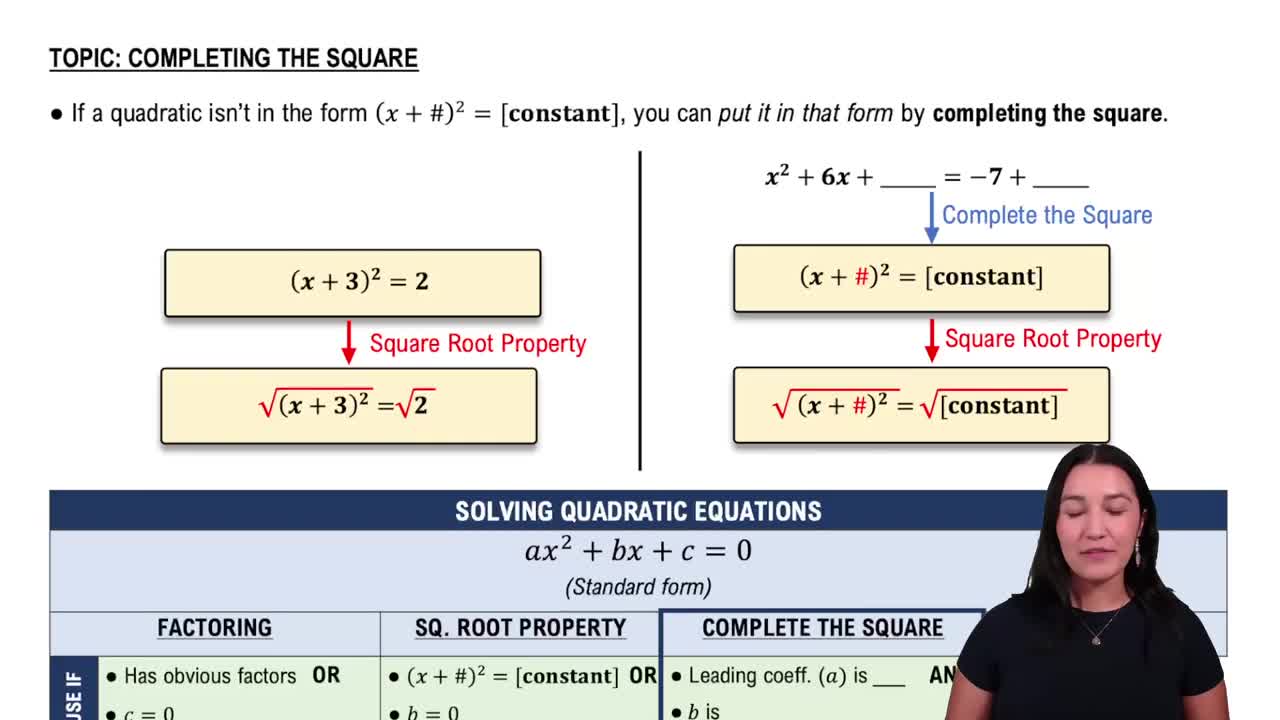
Solving Quadratic Equations by Completing the Square

Simplifying Radicals

After taking the square root, the result may include a radical expression. Simplifying radicals involves reducing the square root to its simplest form, which helps in expressing the solution clearly and accurately.
Video consigliato:
5:48
Adding & Subtracting Unlike Radicals by Simplifying