Ch. 2 - Functions and Graphs
Blitzer - College Algebra 8th Edition
Blitzer8th EditionCollege AlgebraISBN: 9780136970514Non è quello che usi tu?Cambia libro di testo
Capitolo 3, Problema 3

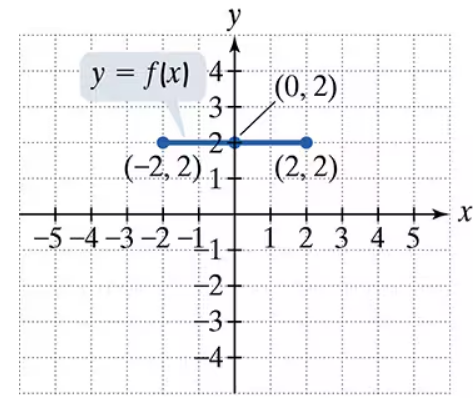
Use the graph of y = f(x) to graph each function g.

g(x) = f(x+1)

Guida verificata passo dopo passo
1
Understand that the function g(x) = f(x + 1) represents a horizontal shift of the original function f(x). Specifically, the graph of f(x) is shifted to the left by 1 unit because the input x is replaced by (x + 1).
Identify key points on the original graph y = f(x). For example, note the coordinates of points where the function changes direction or has important features (like endpoints or peaks).
For each key point (x, y) on the graph of f(x), find the corresponding point on g(x) by subtracting 1 from the x-coordinate. This means the new point will be at (x - 1, y).
Plot these new points on the coordinate plane. Since the function is shifted left, all points move one unit to the left compared to their original positions on f(x).
Connect the new points smoothly, maintaining the shape of the original graph, to complete the graph of g(x) = f(x + 1).

Risposta video verificata per un problema simile:

Questa soluzione video è stata consigliata dai nostri tutor come utile per risolvere questo problema.
Durata del video:
2m

Concetti chiave

Ecco i concetti essenziali che devi comprendere per rispondere correttamente alla domanda.

Function Transformation

Function transformation involves changing the graph of a function by shifting, stretching, compressing, or reflecting it. In this problem, the transformation is a horizontal shift, which moves the graph left or right without altering its shape.
Video consigliato:
4:22
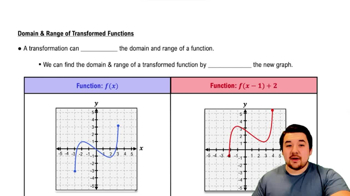
Domain & Range of Transformed Functions

Horizontal Shift

A horizontal shift occurs when the input variable x in the function is replaced by (x + c) or (x - c). For g(x) = f(x + 1), the graph of f(x) shifts 1 unit to the left because adding inside the function moves the graph in the opposite direction of the sign.
Video consigliato:
5:34
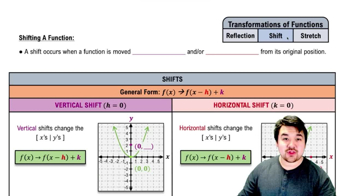
Shifts of Functions

Graph Interpretation

Interpreting graphs requires understanding how points and shapes move under transformations. The image shows the original function f(x) and the shifted function g(x), illustrating how each point on f(x) moves horizontally to create g(x).
Video consigliato:
02:16
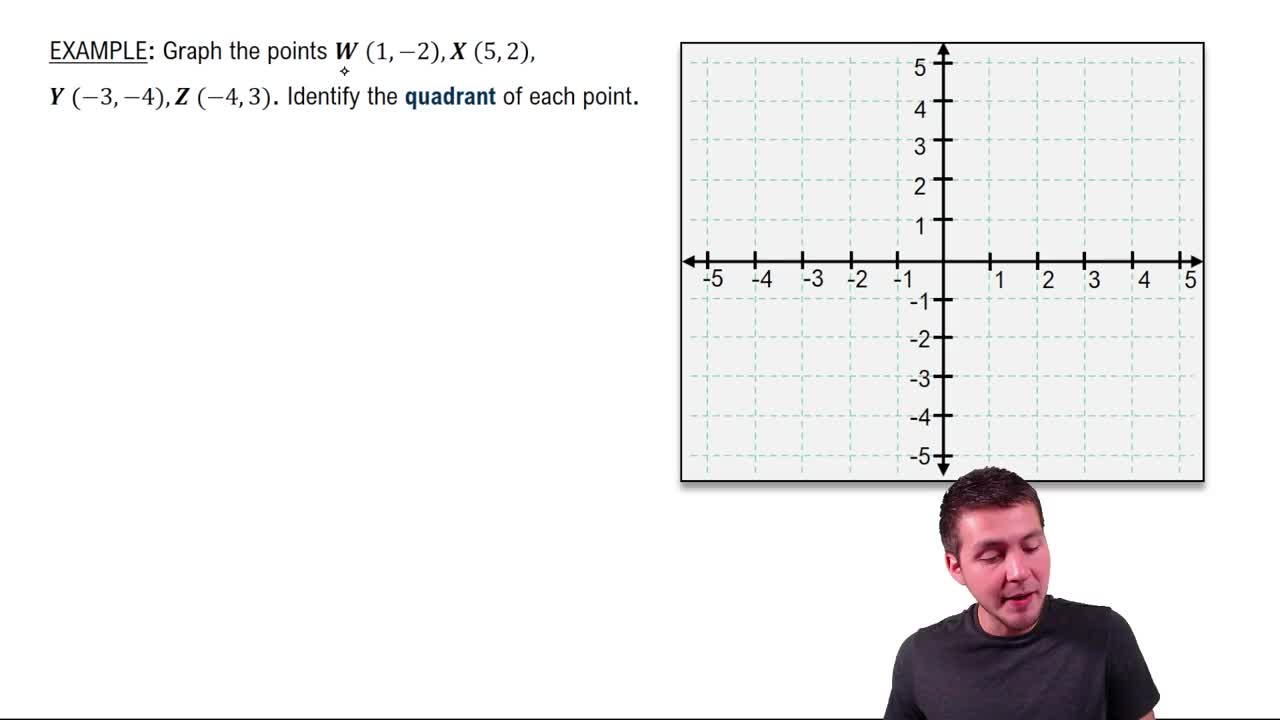
Graphs and Coordinates - Example