Ch. 2 - Functions and Graphs
Blitzer - College Algebra 8th Edition
Blitzer8th EditionCollege AlgebraISBN: 9780136970514Non è quello che usi tu?Cambia libro di testo
Capitolo 3, Problema 101

In Exercises 101–102, find an equation for f^(-1)(x). Then graph f and f^(-1) in the same rectangular coordinate system. f(x) = 1 - x^2, x ≥ 0.

Guida verificata passo dopo passo
1
Step 1: Understand the problem. The goal is to find the inverse function f^(-1)(x) of the given function f(x) = 1 - x^2, where x ≥ 0. The inverse function essentially 'reverses' the operation of the original function.
Step 2: Replace f(x) with y to make the equation easier to work with. This gives y = 1 - x^2. The next step is to solve for x in terms of y.
Step 3: Rearrange the equation to isolate x. Start by subtracting 1 from both sides: y - 1 = -x^2. Then, divide through by -1 to get x^2 = 1 - y.
Step 4: Solve for x by taking the square root of both sides. Since the domain of the original function is x ≥ 0, we only consider the positive square root. This gives x = sqrt(1 - y).
Step 5: Swap x and y to write the inverse function. The inverse function is f^(-1)(x) = sqrt(1 - x). To graph both f(x) and f^(-1)(x), plot f(x) = 1 - x^2 for x ≥ 0 and f^(-1)(x) = sqrt(1 - x) on the same coordinate system. Remember that the graphs of a function and its inverse are symmetric about the line y = x.

Risposta video verificata per un problema simile:

Questa soluzione video è stata consigliata dai nostri tutor come utile per risolvere questo problema.
Durata del video:
2m

Concetti chiave

Ecco i concetti essenziali che devi comprendere per rispondere correttamente alla domanda.

Inverse Functions

An inverse function, denoted as f^(-1)(x), reverses the effect of the original function f(x). For a function to have an inverse, it must be one-to-one, meaning each output is produced by exactly one input. In this case, we need to find f^(-1)(x) for f(x) = 1 - x^2, which is defined for x ≥ 0.
Video consigliato:
4:30
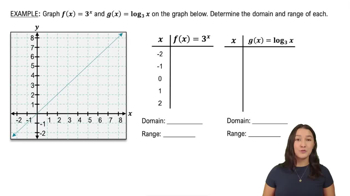
Graphing Logarithmic Functions

Domain and Range

The domain of a function is the set of all possible input values (x-values), while the range is the set of all possible output values (f(x)). For the function f(x) = 1 - x^2 with x ≥ 0, the domain is [0, ∞) and the range is (-∞, 1]. Understanding the domain and range is crucial for accurately finding the inverse function and ensuring it is valid.
Video consigliato:
4:22
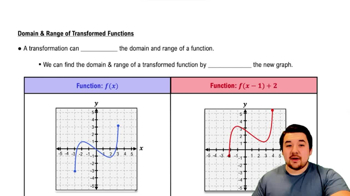
Domain & Range of Transformed Functions

Graphing Functions

Graphing functions involves plotting points on a coordinate system to visualize the relationship between input and output values. When graphing f(x) and its inverse f^(-1)(x), it is important to note that the graphs are reflections over the line y = x. This visual representation helps in understanding how the original function and its inverse relate to each other.
Video consigliato:
5:26
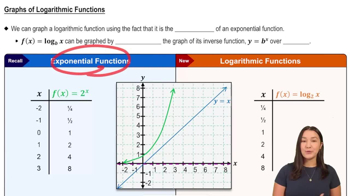
Graphs of Logarithmic Functions