Ch. 2 - Functions and Graphs
Blitzer - College Algebra 8th Edition
Blitzer8th EditionCollege AlgebraISBN: 9780136970514Non è quello che usi tu?Cambia libro di testo
Capitolo 3, Problema 107

Begin by graphing the cube root function, f(x) = ∛x. Then use transformations of this graph to graph the given function. g(x) = ∛x+2

Guida verificata passo dopo passo
1
Start by understanding the parent function f(x) = ∛x. This is the cube root function, which has a characteristic shape. The graph passes through the origin (0, 0), increases to the right, and decreases to the left. It is symmetric about the origin, meaning it is an odd function.
Graph the parent function f(x) = ∛x. Plot key points such as (-8, -2), (-1, -1), (0, 0), (1, 1), and (8, 2). These points are derived from the cube root of x values.
Now, analyze the transformation applied to f(x) to obtain g(x) = ∛x + 2. The '+2' indicates a vertical shift upward by 2 units. This means every point on the graph of f(x) will move 2 units higher.
Apply the vertical shift to the key points of f(x). For example, the point (0, 0) on f(x) becomes (0, 2) on g(x), the point (1, 1) becomes (1, 3), and so on. Adjust all the plotted points accordingly.
Draw the graph of g(x) = ∛x + 2 by connecting the transformed points smoothly, maintaining the same shape as the parent function. Ensure the graph still reflects the cube root function's characteristic behavior, but shifted upward by 2 units.

Risposta video verificata per un problema simile:

Questa soluzione video è stata consigliata dai nostri tutor come utile per risolvere questo problema.
Durata del video:
1m

Concetti chiave

Ecco i concetti essenziali che devi comprendere per rispondere correttamente alla domanda.

Cube Root Function

The cube root function, denoted as f(x) = ∛x, is a type of radical function that returns the number which, when cubed, gives the input x. This function is defined for all real numbers and has a characteristic S-shaped curve that passes through the origin (0,0). Understanding its basic shape and properties is essential for graphing transformations.
Video consigliato:
02:20
Imaginary Roots with the Square Root Property

Graph Transformations

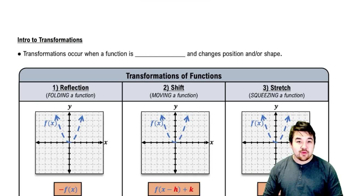
Graph transformations involve shifting, stretching, compressing, or reflecting the graph of a function. In this case, the transformation applied to the cube root function f(x) = ∛x to obtain g(x) = ∛x + 2 is a vertical shift upwards by 2 units. Recognizing how these transformations affect the graph is crucial for accurately sketching the new function.
Video consigliato:
5:25
Intro to Transformations

Vertical Shift

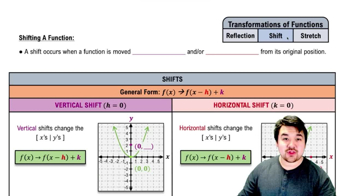
A vertical shift occurs when a function is adjusted by adding or subtracting a constant from its output. For g(x) = ∛x + 2, the '+2' indicates that every point on the graph of f(x) = ∛x is moved up by 2 units. This concept is fundamental in understanding how the graph's position changes without altering its shape.
Video consigliato:
5:34
Shifts of Functions