Ch. 2 - Functions and Graphs
Blitzer - College Algebra 8th Edition
Blitzer8th EditionCollege AlgebraISBN: 9780136970514Non è quello che usi tu?Cambia libro di testo
Capitolo 3, Problema 106

Begin by graphing the standard cubic function, f(x) = x³. Then use transformations of this graph to graph the given function. h(x) = (1/2)(x − 2)³ – 1

Guida verificata passo dopo passo
1
Start by graphing the standard cubic function f(x) = x³. This is the parent function, which has a characteristic S-shaped curve passing through the origin (0, 0). The graph is symmetric about the origin, increasing to the right and decreasing to the left.
Identify the transformations applied to the parent function. The given function is h(x) = (1/2)(x − 2)³ − 1. Notice the transformations: (x − 2)³ represents a horizontal shift 2 units to the right, (1/2) scales the graph vertically by a factor of 1/2, and −1 shifts the graph downward by 1 unit.
Apply the horizontal shift. To shift the graph of f(x) = x³ to the right by 2 units, replace x with (x − 2). This gives the intermediate function g(x) = (x − 2)³.
Apply the vertical scaling. Multiply the intermediate function g(x) = (x − 2)³ by 1/2 to compress the graph vertically. This results in the function h₁(x) = (1/2)(x − 2)³.
Apply the vertical shift. Subtract 1 from h₁(x) = (1/2)(x − 2)³ to shift the graph downward by 1 unit. The final function is h(x) = (1/2)(x − 2)³ − 1. Plot this graph by applying all transformations step by step to the parent function.

Risposta video verificata per un problema simile:

Questa soluzione video è stata consigliata dai nostri tutor come utile per risolvere questo problema.
Durata del video:
10m

Concetti chiave

Ecco i concetti essenziali che devi comprendere per rispondere correttamente alla domanda.

Cubic Functions

A cubic function is a polynomial function of degree three, typically expressed in the form f(x) = ax³ + bx² + cx + d. The standard cubic function, f(x) = x³, has a characteristic 'S' shape and passes through the origin. Understanding its basic shape and properties, such as its inflection point and end behavior, is crucial for graphing transformations.
Video consigliato:
4:56
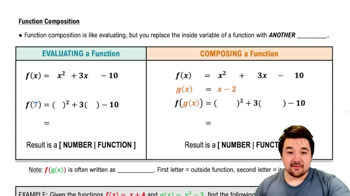
Function Composition

Transformations of Functions

Transformations of functions involve shifting, stretching, compressing, or reflecting the graph of a function. For example, the function h(x) = (1/2)(x − 2)³ – 1 represents a horizontal shift to the right by 2 units, a vertical stretch by a factor of 1/2, and a downward shift by 1 unit. Mastery of these transformations allows for the accurate graphing of modified functions based on their parent functions.
Video consigliato:
4:22
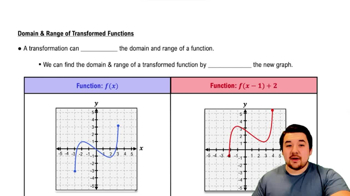
Domain & Range of Transformed Functions

Graphing Techniques

Graphing techniques involve plotting points, identifying key features such as intercepts and turning points, and understanding the overall shape of the graph. For cubic functions, it is important to recognize the symmetry and behavior at infinity. Using transformations, one can apply these techniques to accurately represent the modified function h(x) based on the standard cubic function.
Video consigliato:
02:16
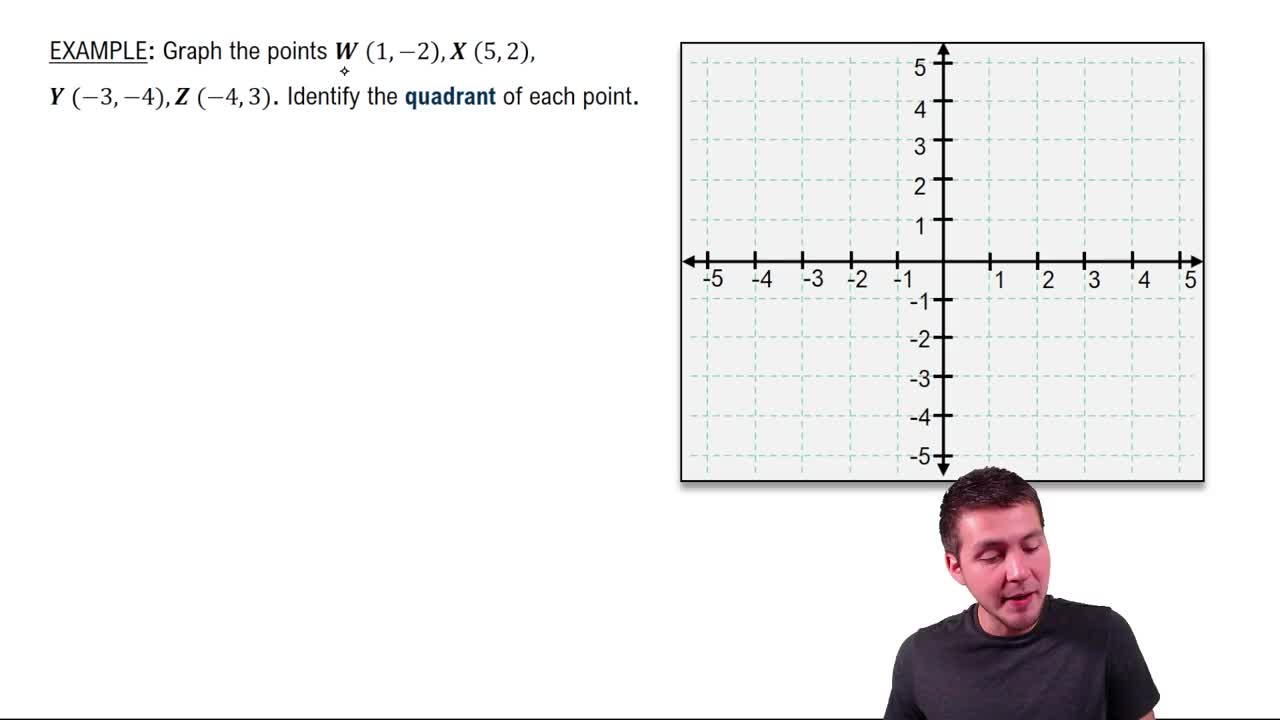
Graphs and Coordinates - Example