Find ƒ+g and determine the domain for each function. f(x) = √x, g(x) = x − 4
Ch. 2 - Functions and Graphs

Capitolo 3, Problema 39b
Find f−g and determine the domain for each function. f(x) = √x, g(x) = x − 4
Guida verificata passo dopo passo1
Step 1: Understand the problem. We are tasked with finding the difference of two functions, denoted as (f − g)(x), which is defined as f(x) − g(x). Additionally, we need to determine the domain of the resulting function.
Step 2: Write the expression for (f − g)(x). Substitute the given functions f(x) = √x and g(x) = x − 4 into the formula for (f − g)(x): (f − g)(x) = f(x) − g(x) = √x − (x − 4).
Step 3: Simplify the expression for (f − g)(x). Distribute the negative sign across the terms in g(x): (f − g)(x) = √x − x + 4.
Step 4: Determine the domain of the resulting function. The domain is the set of all x-values for which the function is defined. For f(x) = √x, the square root requires x ≥ 0. For g(x) = x − 4, there are no restrictions. Therefore, the domain of (f − g)(x) is x ≥ 0.
Step 5: Express the domain in interval notation. Since x must be greater than or equal to 0, the domain is [0, ∞).

Risposta video verificata per un problema simile:
Questa soluzione video è stata consigliata dai nostri tutor come utile per risolvere questo problema.
Durata del video:
2mConcetti chiave
Ecco i concetti essenziali che devi comprendere per rispondere correttamente alla domanda.
Function Operations
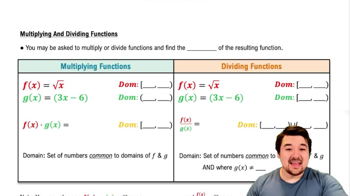
Function operations involve combining two functions to create a new function. In this case, f−g means subtracting the function g(x) from f(x). Understanding how to perform operations on functions is essential for manipulating and analyzing their behavior.
Video consigliato:
Multiplying & Dividing Functions
Domain of a Function
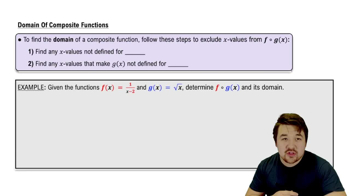
The domain of a function is the set of all possible input values (x-values) for which the function is defined. For f(x) = √x, the domain is x ≥ 0, as square roots of negative numbers are not defined in the real number system. When combining functions, the domain of the resulting function must consider the domains of both original functions.
Video consigliato:
Domain Restrictions of Composed Functions
Piecewise Functions
Piecewise functions are defined by different expressions based on the input value. When finding f−g, the resulting function may need to be expressed piecewise if the domains of f and g do not overlap. This concept is crucial for accurately determining the domain of the combined function.
Video consigliato:
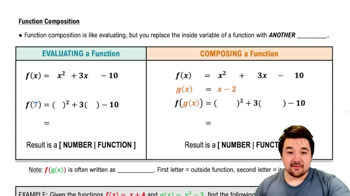
Function Composition
Pratica correlata
Domanda del libro di testo
1033
views
Domanda del libro di testo
In Exercises 39-52, a. Find an equation for ƒ¯¹(x). b. Graph ƒ and ƒ¯¹(x) in the same rectangular coordinate system. c. Use interval notation to give the domain and the range of f and ƒ¯¹. f(x)=2x-1
597
views
Domanda del libro di testo
Find f/g and determine the domain for each function. f(x) = √x, g(x) = x − 4
1112
views
Domanda del libro di testo
Graph the given functions, f and g, in the same rectangular coordinate system. Select integers for x, starting with -2 and ending with 2. Once you have obtained your graphs, describe how the graph of g is related to the graph of f. f(x) = x, g(x) = x + 3
862
views
Domanda del libro di testo
Find fg and determine the domain for each function. f(x) = √x, g(x) = x − 4
1181
views
Domanda del libro di testo
Find , , , and . Determine the domain for each function.
,
717
views