Ch. 2 - Functions and Graphs
Blitzer - College Algebra 8th Edition
Blitzer8th EditionCollege AlgebraISBN: 9780136970514Non è quello che usi tu?Cambia libro di testo
Capitolo 3, Problema 41c

Find fg and determine the domain for each function. f(x) = 2 + 1/x, g(x) = 1/x

Guida verificata passo dopo passo
1
Step 1: Understand the problem. You are tasked with finding the composition of two functions, fg(x), which means f(g(x)). This involves substituting g(x) into f(x). Additionally, you need to determine the domain of the resulting function.
Step 2: Write the expression for fg(x). Start by substituting g(x) = 1/x into f(x) = 2 + 1/x. This gives fg(x) = 2 + 1/(1/x).
Step 3: Simplify the expression for fg(x). Use the property of fractions that 1/(1/x) = x. Substituting this back, fg(x) simplifies to fg(x) = 2 + x.
Step 4: Determine the domain of fg(x). The domain of a function is the set of all x-values for which the function is defined. For g(x) = 1/x, x cannot be 0 because division by zero is undefined. Similarly, for f(x) = 2 + 1/x, x cannot be 0. Since fg(x) = 2 + x does not involve division by x, the only restriction comes from g(x), so x ≠ 0.
Step 5: Conclude the solution. The composition fg(x) = 2 + x, and the domain of fg(x) is all real numbers except x = 0, which can be written as (-∞, 0) ∪ (0, ∞).

Risposta video verificata per un problema simile:

Questa soluzione video è stata consigliata dai nostri tutor come utile per risolvere questo problema.
Durata del video:
8m

Concetti chiave

Ecco i concetti essenziali che devi comprendere per rispondere correttamente alla domanda.

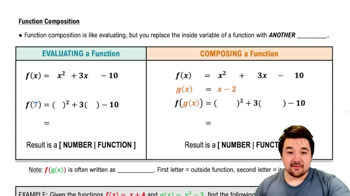
Function Composition

Function composition involves combining two functions, where the output of one function becomes the input of another. In this case, fg means f(g(x)), which requires substituting g(x) into f(x). Understanding how to perform this substitution is crucial for finding the composite function.
Video consigliato:
4:56
Function Composition

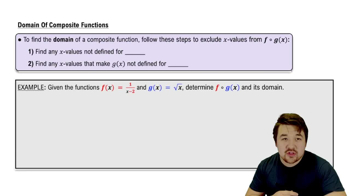
Domain of a Function

The domain of a function is the set of all possible input values (x-values) for which the function is defined. For rational functions like f(x) = 2 + 1/x and g(x) = 1/x, the domain excludes values that make the denominator zero, as these would result in undefined expressions.
Video consigliato:
3:51
Domain Restrictions of Composed Functions

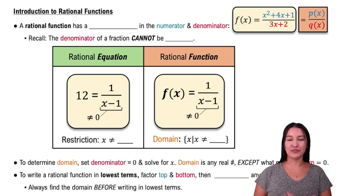
Rational Functions

Rational functions are ratios of polynomials, and they often have restrictions on their domains due to potential division by zero. In this problem, both f(x) and g(x) are rational functions, and understanding their behavior, particularly at points where the denominator is zero, is essential for determining their domains and the composite function.
Video consigliato:
6:04
Intro to Rational Functions