Ch. 2 - Functions and Graphs
Blitzer - College Algebra 8th Edition
Blitzer8th EditionCollege AlgebraISBN: 9780136970514Non è quello che usi tu?Cambia libro di testo
Capitolo 3, Problema 41a

Find ƒ+g and determine the domain for each function. f(x) = 2 + 1/x, g(x) = 1/x

Guida verificata passo dopo passo
1
Step 1: Understand the problem. You are tasked with finding the sum of two functions, f(x) and g(x), which is denoted as (f + g)(x). This means you need to add the two given functions together: f(x) = 2 + 1/x and g(x) = 1/x.
Step 2: Write the expression for (f + g)(x). Add the two functions together: (f + g)(x) = f(x) + g(x) = (2 + 1/x) + (1/x).
Step 3: Combine like terms. Simplify the expression by combining the terms involving 1/x: (f + g)(x) = 2 + 1/x + 1/x = 2 + 2/x.
Step 4: Determine the domain of the resulting function. The domain of a function is the set of all x-values for which the function is defined. For this problem, note that both f(x) and g(x) contain the term 1/x, which is undefined when x = 0. Therefore, the domain of (f + g)(x) excludes x = 0.
Step 5: Express the domain in interval notation. Since x = 0 is excluded, the domain is all real numbers except 0. In interval notation, this is written as (-∞, 0) ∪ (0, ∞).

Risposta video verificata per un problema simile:

Questa soluzione video è stata consigliata dai nostri tutor come utile per risolvere questo problema.
Durata del video:
3m

Concetti chiave

Ecco i concetti essenziali che devi comprendere per rispondere correttamente alla domanda.

Function Addition

Function addition involves combining two functions by adding their outputs for each input. For functions f(x) and g(x), the sum is defined as (f + g)(x) = f(x) + g(x). This operation requires evaluating both functions at the same input value and summing the results.
Video consigliato:
4:46
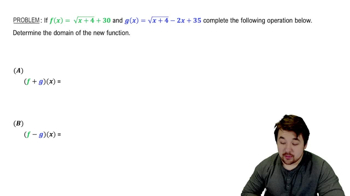
Adding & Subtracting Functions Example 1

Domain of a Function

The domain of a function is the set of all possible input values (x-values) for which the function is defined. For rational functions like f(x) = 2 + 1/x and g(x) = 1/x, the domain excludes values that make the denominator zero, as these would result in undefined outputs.
Video consigliato:
3:51
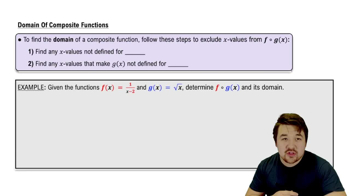
Domain Restrictions of Composed Functions

Rational Functions

Rational functions are ratios of polynomials, expressed in the form f(x) = P(x)/Q(x), where P and Q are polynomials. The behavior of rational functions, including their domains and asymptotes, is influenced by the zeros of the denominator, which dictate where the function is undefined.
Video consigliato:
6:04
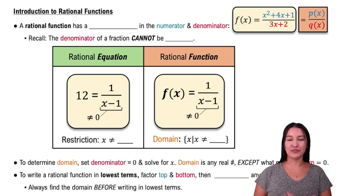
Intro to Rational Functions