In Exercises 31–50, find ƒ+g, f−g, fg, and f/g. Determine the domain for each function. f(x) = √(x -2), g(x) = √(2-x)
Ch. 2 - Functions and Graphs

Capitolo 3, Problema 49a
Find ƒ+g, f−g, fg, and f/g. Determine the domain for each function. f(x) = √(x -2), g(x) = √(2-x)
Guida verificata passo dopo passo1
Step 1: Understand the problem. We are tasked with finding the sum (ƒ+g), difference (ƒ−g), product (ƒg), and quotient (ƒ/g) of the two functions ƒ(x) = √(x - 2) and g(x) = √(2 - x). Additionally, we need to determine the domain for each resulting function.
Step 2: Find ƒ+g. The sum of the two functions is given by (ƒ+g)(x) = ƒ(x) + g(x). Substituting the given functions, we have (ƒ+g)(x) = √(x - 2) + √(2 - x). To determine the domain, both square roots must be defined, meaning the expressions inside the square roots must be non-negative. Solve x - 2 ≥ 0 and 2 - x ≥ 0 to find the domain.
Step 3: Find ƒ−g. The difference of the two functions is given by (ƒ−g)(x) = ƒ(x) - g(x). Substituting the given functions, we have (ƒ−g)(x) = √(x - 2) - √(2 - x). The domain is the same as in Step 2, as it depends on the square root expressions being defined.
Step 4: Find ƒg. The product of the two functions is given by (ƒg)(x) = ƒ(x) * g(x). Substituting the given functions, we have (ƒg)(x) = √(x - 2) * √(2 - x). The domain is again determined by ensuring both square roots are defined, as in Step 2.
Step 5: Find ƒ/g. The quotient of the two functions is given by (ƒ/g)(x) = ƒ(x) / g(x). Substituting the given functions, we have (ƒ/g)(x) = √(x - 2) / √(2 - x). In addition to the domain restrictions from Step 2, we must also ensure that the denominator √(2 - x) ≠ 0. Solve 2 - x ≠ 0 to refine the domain.

Risposta video verificata per un problema simile:
Questa soluzione video è stata consigliata dai nostri tutor come utile per risolvere questo problema.
Durata del video:
3mConcetti chiave
Ecco i concetti essenziali che devi comprendere per rispondere correttamente alla domanda.
Function Operations
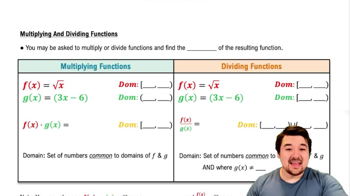
Function operations involve combining two functions through addition, subtraction, multiplication, and division. For functions f and g, these operations are defined as (f + g)(x) = f(x) + g(x), (f - g)(x) = f(x) - g(x), (fg)(x) = f(x) * g(x), and (f/g)(x) = f(x) / g(x), provided that g(x) is not zero.
Video consigliato:
Multiplying & Dividing Functions
Domain of a Function
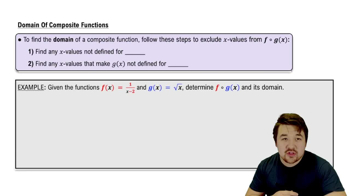
The domain of a function is the set of all possible input values (x-values) for which the function is defined. For functions involving square roots, the expression inside the square root must be non-negative. Therefore, determining the domain requires solving inequalities to find the valid x-values for each function.
Video consigliato:
Domain Restrictions of Composed Functions
Square Root Functions
Square root functions, such as f(x) = √(x - 2) and g(x) = √(2 - x), are defined only for values that make the expression under the square root non-negative. This means that for f(x), x must be greater than or equal to 2, while for g(x), x must be less than or equal to 2. Understanding these constraints is crucial for determining the domain of the combined functions.
Video consigliato:
Imaginary Roots with the Square Root Property
Pratica correlata
Domanda del libro di testo
1020
views
Domanda del libro di testo
Graph each equation in a rectangular coordinate system. y = -2
1438
views
Domanda del libro di testo
In Exercises 39-52, a. Find an equation for ƒ¯¹(x). b. Graph ƒ and ƒ¯¹(x) in the same rectangular coordinate system. c. Use interval notation to give the domain and the range off and ƒ¯¹. f(x) = √(x-1)
623
views
Domanda del libro di testo
In Exercises 41–52, give the center and radius of the circle described by the equation and graph each equation. Use the graph to identify the relation's domain and range. x² + (y − 1)² = 1
956
views
Domanda del libro di testo
In Exercises 46–49, give the slope and y-intercept of each line whose equation is given. Then graph the line. 2x + 3y + 6 = 0
1444
views
Domanda del libro di testo
In Exercises 31–50, find ƒ+g, f−g, fg, and f/g. Determine the domain for each function. f(x) = √(x -2), g(x) = √(2-x)
1046
views