Ch. 2 - Functions and Graphs
Blitzer - College Algebra 8th Edition
Blitzer8th EditionCollege AlgebraISBN: 9780136970514Non è quello che usi tu?Cambia libro di testo
Capitolo 3, Problema 37

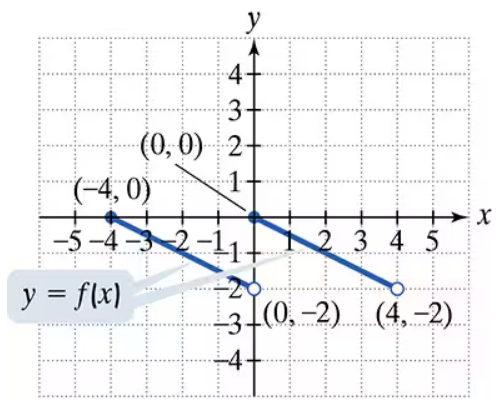
Use the graph of y = f(x) to graph each function g. g(x) = -f(x+2)

Guida verificata passo dopo passo
1
Start by understanding the given function g(x) = -f(x+2). This function is a transformation of the original function y = f(x). The transformations include a horizontal shift, a reflection, and a vertical scaling.
Identify the horizontal shift: The term (x+2) inside the function indicates a horizontal shift. Specifically, it shifts the graph of f(x) 2 units to the left. This is because adding a positive value inside the parentheses moves the graph in the negative x-direction.
Apply the reflection: The negative sign outside the function, -f(x+2), reflects the graph of f(x+2) across the x-axis. This means that all y-values of the graph are multiplied by -1, flipping the graph upside down.
Combine the transformations: First, shift the graph of f(x) 2 units to the left. Then, reflect the resulting graph across the x-axis. This gives you the graph of g(x).
Sketch the graph: Use the transformations step by step to modify the graph of f(x). Start with the horizontal shift, then apply the reflection. Label key points and features (like intercepts and turning points) to ensure accuracy in your graph.

Risposta video verificata per un problema simile:

Questa soluzione video è stata consigliata dai nostri tutor come utile per risolvere questo problema.
Durata del video:
1m

Concetti chiave

Ecco i concetti essenziali che devi comprendere per rispondere correttamente alla domanda.

Function Transformation

Function transformation refers to the changes made to the graph of a function based on modifications to its equation. These transformations include shifts, reflections, stretches, and compressions. Understanding how to manipulate the function's equation allows one to predict how the graph will change, which is essential for graphing functions like g(x) = -f(x+2).
Video consigliato:
4:22
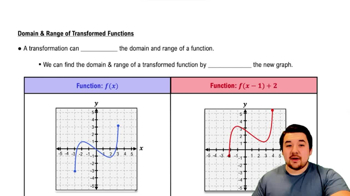
Domain & Range of Transformed Functions

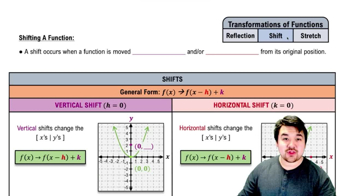
Horizontal Shifts

A horizontal shift occurs when a function is translated left or right on the Cartesian plane. In the function g(x) = -f(x+2), the term (x+2) indicates a shift of the graph of f(x) to the left by 2 units. This concept is crucial for accurately positioning the graph of g in relation to f.
Video consigliato:
5:34
Shifts of Functions

Vertical Reflection

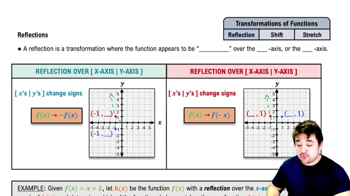
Vertical reflection involves flipping the graph of a function over the x-axis. In the function g(x) = -f(x+2), the negative sign before f indicates that the graph of f will be reflected vertically. This transformation changes the sign of the output values, which is important for understanding how the graph of g relates to that of f.
Video consigliato:
5:00
Reflections of Functions