In Exercises 41–44, use the given conditions to write an equation for each line in point-slope form and slope-intercept form. Passing through (-3, 2) with slope - 6
Ch. 2 - Functions and Graphs

Capitolo 3, Problema 41
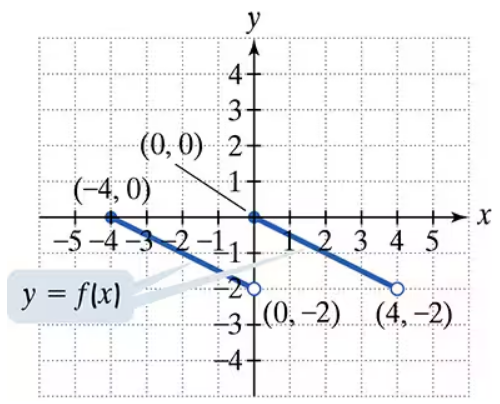
Use the graph of y = f(x) to graph each function g. g(x) = -½ ƒ ( x + 2) - 2

Guida verificata passo dopo passo1
Start by understanding the transformations applied to the base function y = f(x). The given function g(x) = -½ ƒ(x + 2) - 2 involves multiple transformations: a horizontal shift, a vertical stretch/compression, a reflection, and a vertical shift.
Identify the horizontal shift: The term (x + 2) inside the function indicates a horizontal shift to the left by 2 units. This means every point on the graph of f(x) will move 2 units to the left.
Determine the vertical stretch/compression and reflection: The coefficient -½ in front of ƒ(x + 2) indicates two transformations. The negative sign reflects the graph across the x-axis, and the factor of ½ compresses the graph vertically by a factor of ½. This means the y-values of the graph will be halved and flipped in sign.
Account for the vertical shift: The -2 at the end of the function indicates a vertical shift downward by 2 units. This means every point on the graph will move 2 units down.
Combine all transformations: To graph g(x), start with the graph of y = f(x). First, shift the graph 2 units to the left. Then, reflect it across the x-axis and compress it vertically by a factor of ½. Finally, shift the resulting graph 2 units downward. Plot the transformed points to complete the graph of g(x).

Risposta video verificata per un problema simile:
Questa soluzione video è stata consigliata dai nostri tutor come utile per risolvere questo problema.
Durata del video:
6mConcetti chiave
Ecco i concetti essenziali che devi comprendere per rispondere correttamente alla domanda.
Function Transformation
Function transformation involves altering the graph of a function through various operations such as shifting, reflecting, stretching, or compressing. In the given function g(x) = -½ f(x + 2) - 2, the transformations include a horizontal shift to the left by 2 units, a vertical compression by a factor of ½, and a vertical shift downward by 2 units.
Video consigliato:
Domain & Range of Transformed Functions
Horizontal Shifts
Horizontal shifts occur when the input of a function is adjusted by adding or subtracting a constant. For g(x) = -½ f(x + 2), the '+2' indicates a shift to the left by 2 units on the x-axis. This means that every point on the graph of f(x) will move leftward, affecting the overall position of the graph of g(x).
Video consigliato:
Shifts of Functions
Vertical Shifts and Reflections
Vertical shifts involve moving the graph of a function up or down by adding or subtracting a constant from the function's output. In g(x), the '-2' indicates a downward shift of 2 units. Additionally, the negative sign in front of the ½ reflects the graph across the x-axis, inverting its orientation while also compressing it vertically by a factor of ½.
Video consigliato:
Graphs of Shifted & Reflected Functions
Pratica correlata
Domanda del libro di testo
1162
views
Domanda del libro di testo
Find ƒ+g and determine the domain for each function. f(x) = 2 + 1/x, g(x) = 1/x
862
views
Domanda del libro di testo
In Exercises 39-52, a. Find an equation for ƒ¯¹(x). b. Graph ƒ and ƒ¯¹(x) in the same rectangular coordinate system. c. Use interval notation to give the domain and the range of f and ƒ¯¹. ƒ(x) = x² − 4, x ≥ 0
666
views
Domanda del libro di testo
Give the center and radius of the circle described by the equation and graph each equation. Use the graph to identify the relation's domain and range. x² + y² = 16
867
views
Domanda del libro di testo
Find ƒ-g and determine the domain for each function. f(x) = 2 + 1/x, g(x) = 1/x
1064
views
Domanda del libro di testo
In Exercises 39–48, give the slope and y-intercept of each line whose equation is given. Then graph the linear function. f(x) = -2x+1
132
views