Ch. 2 - Functions and Graphs
Blitzer - College Algebra 8th Edition
Blitzer8th EditionCollege AlgebraISBN: 9780136970514Non è quello che usi tu?Cambia libro di testo
Capitolo 3, Problema 64

Let f(x) = 2x - 5 g(x) = 4x - 1 h(x) = x² + x + 2. Evaluate the indicated function without finding an equation for the function. f(g[h (1)])

Guida verificata passo dopo passo
1
First, identify the innermost function to evaluate, which is \( h(1) \). Substitute \( x = 1 \) into \( h(x) = x^2 + x + 2 \) to find \( h(1) \).
Next, take the result from \( h(1) \) and substitute it into \( g(x) = 4x - 1 \) to find \( g(h(1)) \).
Then, take the result from \( g(h(1)) \) and substitute it into \( f(x) = 2x - 5 \) to find \( f(g(h(1))) \).
Remember to perform each substitution step carefully, simplifying the expressions at each stage before moving to the next function.
By following these steps, you will evaluate \( f(g(h(1))) \) without needing to find the composite function's explicit formula.

Risposta video verificata per un problema simile:

Questa soluzione video è stata consigliata dai nostri tutor come utile per risolvere questo problema.
Durata del video:
3m

Concetti chiave

Ecco i concetti essenziali che devi comprendere per rispondere correttamente alla domanda.

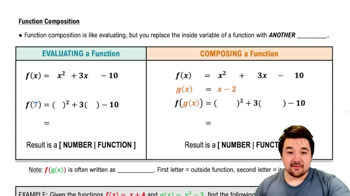
Function Composition

Function composition involves applying one function to the result of another, denoted as (f ∘ g)(x) = f(g(x)). In this problem, you evaluate functions inside out, starting with the innermost function h(1), then applying g to that result, and finally f to the output of g.
Video consigliato:
4:56
Function Composition

Evaluating Functions at a Given Input

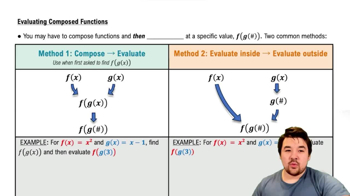
Evaluating a function means substituting a specific value for the variable and simplifying. For example, to find h(1), replace x with 1 in h(x) = x² + x + 2 and calculate the result. This step-by-step substitution is essential for nested function evaluation.
Video consigliato:
4:26
Evaluating Composed Functions

Order of Operations in Nested Functions

When dealing with nested functions like f(g(h(1))), you must follow the order from the innermost function outward. First evaluate h(1), then use that result as input for g, and finally apply f to the output of g. This ensures accurate and systematic calculation.
Video consigliato:
7:24
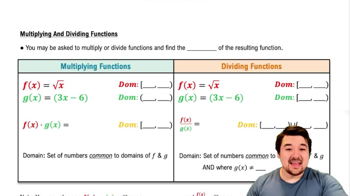
Multiplying & Dividing Functions