Ch. 2 - Functions and Graphs
Blitzer - College Algebra 8th Edition
Blitzer8th EditionCollege AlgebraISBN: 9780136970514Non è quello che usi tu?Cambia libro di testo
Capitolo 3, Problema 60

In Exercises 60–63, begin by graphing the standard quadratic function, f(x) = x^2. Then use transformations of this graph to graph the given function. g(x) = x^2 + 2

Guida verificata passo dopo passo
1
Start by identifying the standard quadratic function, f(x) = x^2. This is a parabola that opens upwards with its vertex at the origin (0, 0). The graph is symmetric about the y-axis.
Next, observe the given function, g(x) = x^2 + 2. Notice that this is a transformation of the standard quadratic function. Specifically, the '+2' indicates a vertical shift.
To apply the vertical shift, move every point on the graph of f(x) = x^2 upward by 2 units. For example, the vertex of f(x) = x^2, which is at (0, 0), will now move to (0, 2).
Plot the new points after the vertical shift. For instance, if the original graph of f(x) = x^2 passes through (1, 1), the new graph will pass through (1, 3). Similarly, if it passes through (-1, 1), the new graph will pass through (-1, 3).
Finally, sketch the new graph of g(x) = x^2 + 2. It will have the same shape as the original parabola, but its vertex will be at (0, 2), and the entire graph will be shifted 2 units upward.

Risposta video verificata per un problema simile:

Questa soluzione video è stata consigliata dai nostri tutor come utile per risolvere questo problema.
Durata del video:
1m

Concetti chiave

Ecco i concetti essenziali che devi comprendere per rispondere correttamente alla domanda.

Quadratic Functions

A quadratic function is a polynomial function of degree two, typically expressed in the form f(x) = ax^2 + bx + c. The graph of a quadratic function is a parabola, which opens upwards if 'a' is positive and downwards if 'a' is negative. Understanding the basic shape and properties of quadratic functions is essential for analyzing their transformations.
Video consigliato:
06:36
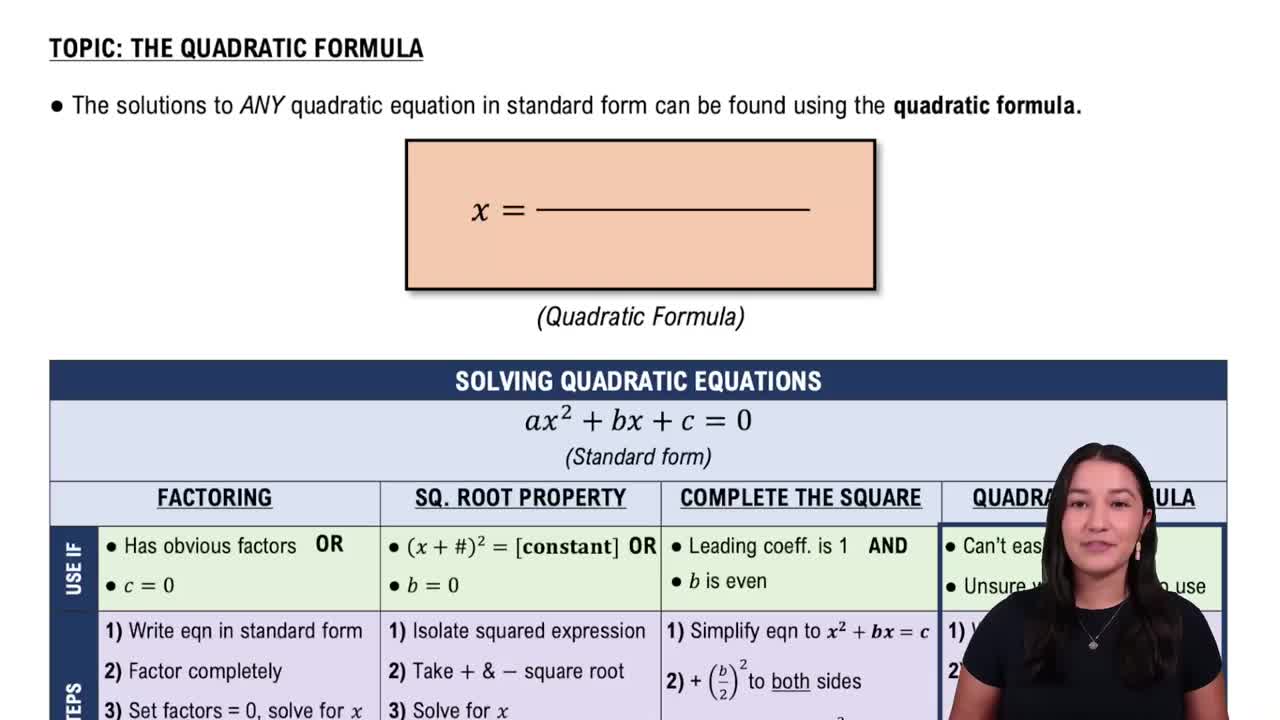
Solving Quadratic Equations Using The Quadratic Formula

Graph Transformations

Graph transformations involve shifting, reflecting, stretching, or compressing the graph of a function. For quadratic functions, vertical shifts occur when a constant is added or subtracted from the function, such as in g(x) = x^2 + 2, which shifts the graph of f(x) = x^2 upward by 2 units. Recognizing these transformations helps in accurately graphing modified functions.
Video consigliato:
5:25
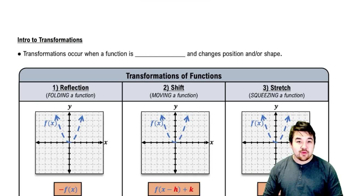
Intro to Transformations

Standard Form of a Quadratic Function

The standard form of a quadratic function is f(x) = ax^2 + bx + c, where 'a', 'b', and 'c' are constants. This form allows for easy identification of the vertex and the direction of the parabola. In the context of transformations, understanding how changes in 'c' affect the graph's position is crucial for accurately representing the function g(x) = x^2 + 2.
Video consigliato:
04:34
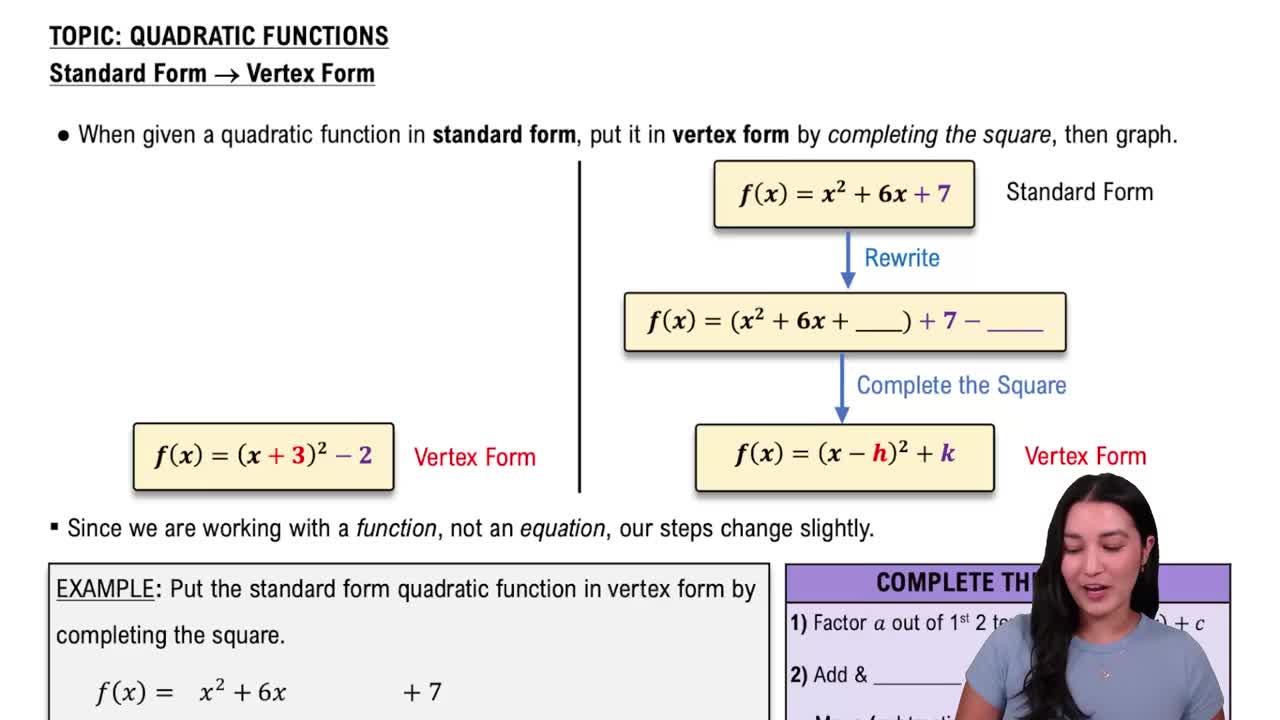
Converting Standard Form to Vertex Form