In Exercises 59-66, a. Rewrite the given equation in slope-intercept form. b. Give the slope and y-intercept. c. Use the slope and y-intercept to graph the linear function. 4y+ 28 = 0
Ch. 2 - Functions and Graphs

Capitolo 3, Problema 66
In Exercises 64–66, begin by graphing the square root function, f(x) = √x. Then use transformations of this graph to graph the given function. r(x) = 2√(x + 2)
Guida verificata passo dopo passo1
Start with the basic square root function \(f(x) = \sqrt{x}\), which is graphed starting at the point \((0,0)\) and increases slowly as \(x\) increases.
Identify the transformation inside the square root: \(r(x) = 2\sqrt{x + 2}\). The expression \(x + 2\) inside the square root indicates a horizontal shift to the left by 2 units.
Apply the horizontal shift by moving every point on the graph of \(f(x) = \sqrt{x}\) two units to the left. For example, the point \((0,0)\) on \(f(x)\) moves to \((-2,0)\) on \(r(x)\).
Next, observe the coefficient 2 outside the square root, which means a vertical stretch by a factor of 2. Multiply all the \(y\)-values of the shifted graph by 2.
Combine these transformations: first shift the graph of \(f(x)\) left by 2 units, then stretch it vertically by a factor of 2 to get the graph of \(r(x) = 2\sqrt{x + 2}\).

Risposta video verificata per un problema simile:
Questa soluzione video è stata consigliata dai nostri tutor come utile per risolvere questo problema.
Durata del video:
6mConcetti chiave
Ecco i concetti essenziali che devi comprendere per rispondere correttamente alla domanda.
Square Root Function
The square root function, f(x) = √x, is defined for x ≥ 0 and produces non-negative outputs. Its graph starts at the origin (0,0) and increases slowly, forming a curve that rises to the right. Understanding this base graph is essential before applying any transformations.
Video consigliato:
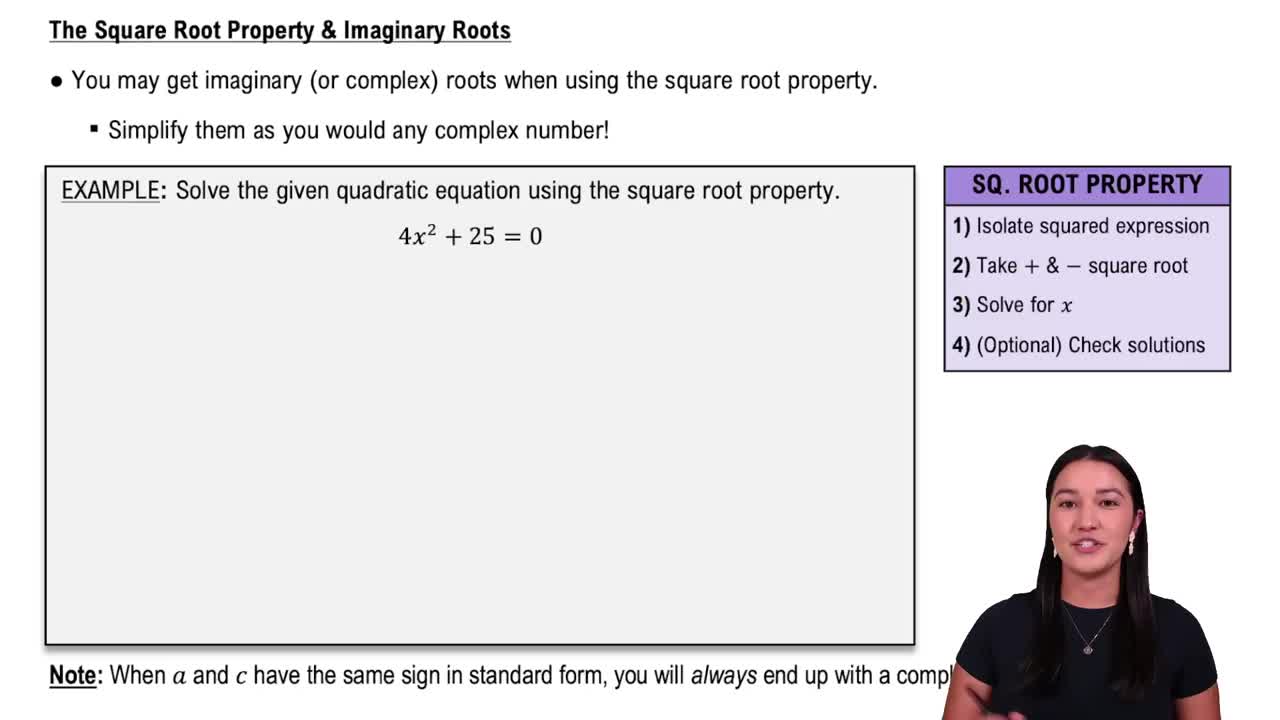
Imaginary Roots with the Square Root Property
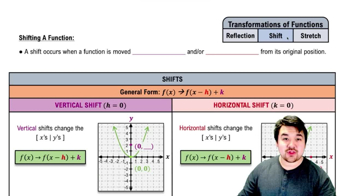
Horizontal Shifts of Functions
A horizontal shift occurs when a constant is added or subtracted inside the function's argument, such as in f(x + c). For f(x + 2), the graph shifts 2 units to the left. This transformation changes the starting point of the graph along the x-axis without altering its shape.
Video consigliato:
Shifts of Functions
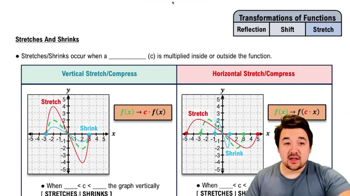
Vertical Stretching of Functions
Multiplying a function by a constant greater than 1, like 2√(x + 2), stretches the graph vertically. This means all y-values are multiplied by 2, making the graph steeper. Vertical stretching affects the output values but does not shift the graph horizontally.
Video consigliato:
Stretches & Shrinks of Functions
Pratica correlata
Domanda del libro di testo
107
views
Domanda del libro di testo
Find a. (fog) (x) b. (go f) (x) c. (fog) (2) d. (go f) (2).
f(x) = 1/x, g(x)= 1/x
867
views
Domanda del libro di testo
A line segment through the center of each circle intersects the circle at the points shown. a. Find the coordinates of the circle's center. b. Find the radius of the circle. c. Use your answers from parts (a) and (b) to write the standard form of the circle's equation.
849
views
Domanda del libro di testo
Begin by graphing the standard quadratic function, f(x) = x². Then use transformations of this graph to graph the given function. h(x) = -2(x+2)²+1
711
views
Domanda del libro di testo
Use the graph of f to find each indicated function value.
f(-2)
754
views
Domanda del libro di testo
In Exercises 67-74, find a. (fog) (x) b. the domain of f o g. f(x) = 2/(x+3), g(x) = 1/x
1678
views