Ch. 2 - Functions and Graphs
Blitzer - College Algebra 8th Edition
Blitzer8th EditionCollege AlgebraISBN: 9780136970514Non è quello che usi tu?Cambia libro di testo
Capitolo 3, Problema 85

In Exercises 77–92, use the graph to determine a. the function's domain; b. the function's range; c. the x-intercepts, if any; d. the y-intercept, if any; and e. the missing function values, indicated by question marks, below each graph.
Graph of a decreasing linear function with points at (-2,5) and (5,-2) and a missing value at f(-1).

Guida verificata passo dopo passo
1
Step 1: Determine the domain of the function by looking at the x-values covered by the graph. Since the graph extends from x = -2 to x = 5, the domain is all x such that \(-2 \leq x \leq 5\).
Step 2: Determine the range of the function by looking at the y-values covered by the graph. The graph goes from y = 5 down to y = -2, so the range is all y such that \(-2 \leq y \leq 5\).
Step 3: Find the x-intercept(s) by identifying where the graph crosses the x-axis (where \(y=0\)). Locate the point on the graph where the line crosses the x-axis and note the x-coordinate.
Step 4: Find the y-intercept by identifying where the graph crosses the y-axis (where \(x=0\)). Locate the point on the graph where the line crosses the y-axis and note the y-coordinate.
Step 5: To find the missing function value \(f(-1)\), use the two known points on the line, \((-2,5)\) and \((5,-2)\), to find the slope \(m\) using the formula \(m = \frac{y_2 - y_1}{x_2 - x_1}\). Then use the point-slope form of the line equation to find \(f(-1)\) by substituting \(x = -1\).

Risposta video verificata per un problema simile:

Questa soluzione video è stata consigliata dai nostri tutor come utile per risolvere questo problema.
Durata del video:
3m

Concetti chiave

Ecco i concetti essenziali che devi comprendere per rispondere correttamente alla domanda.

Domain of a Function

The domain of a function is the set of all possible input values (x-values) for which the function is defined. In the context of a graph, the domain corresponds to the horizontal extent of the graph, including all x-values covered by the function's curve or line.
Video consigliato:
3:51
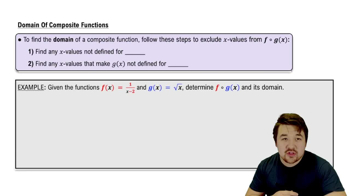
Domain Restrictions of Composed Functions

Range of a Function

The range of a function is the set of all possible output values (y-values) that the function can produce. On a graph, the range is represented by the vertical span of the function's graph, showing all y-values that correspond to the domain.
Video consigliato:
4:22
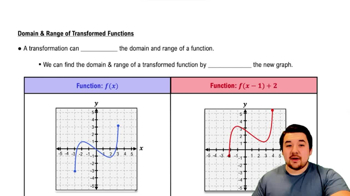
Domain & Range of Transformed Functions

Finding Function Values from a Graph

To find a specific function value like f(-1), locate the input value on the x-axis and find the corresponding point on the graph. The y-coordinate of this point is the function value. This process uses the graph to evaluate the function at given inputs.
Video consigliato:
5:10
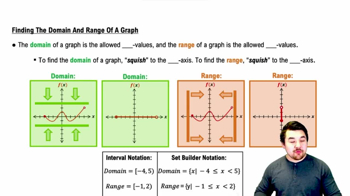
Finding the Domain and Range of a Graph